Plastic extrusion is a continuous manufacturing process that melts polymer material, pushes it through a die, and shapes it into a product or an intermediate form for the next step. For industrial projects, the most useful way to understand types of plastic extrusion is to group them by what the extrusion line delivers: finished profiles, sheets, pipes, coatings, or pellets for downstream molding and extrusion.
This guide explains the main plastic extrusion types you will encounter in production planning, what each process is best for, and how to choose between single screw extrusion and twin screw extrusion when your target is recycling, compounding, or pelletizing. It also shows how HONGQI’s equipment design supports higher output and stable operation for commercial-grade production.
View The Product:
Profile Extrusion For Frames, Seals, And Structural Shapes
Profile extrusion creates continuous shapes with a consistent cross-section, such as window frames, door seals, edge trims, and functional strips. The die design defines the final geometry, and calibration tooling stabilizes dimensions while the profile cools.
Efficiency in profile extrusion depends on stable melt temperature, consistent haul-off speed, and dimensional control. If the melt is under-mixed or temperature fluctuates, profiles can warp, shrink unevenly, or show surface defects. For profile-focused lines, process stability often matters more than peak screw speed because downstream sizing and cooling must keep up with the extrudate.
Key planning points include:
Material consistency and dryness for tight dimensional tolerances
Die design and calibration set quality more than screw diameter alone
Cooling length and haul-off stability define line speed ceiling
Sheet And Film Extrusion For Flat Plastic Products
Sheet extrusion and film extrusion produce flat products used for packaging, thermoforming, insulation, and protective layers. Sheet typically runs thicker and may use chill rolls to control thickness and surface finish. Film extrusion often needs tighter control of melt strength, bubble stability (for blown film), or die gap precision (for cast film).
Where efficiency is lost:
Gauge variation that forces operators to slow down to stabilize thickness
Insufficient melt filtration that causes die lines and frequent clean-outs
Unstable temperature profile that increases scrap during changeovers
When sheet or film quality targets are demanding, melt filtration and temperature control become the core efficiency levers because downtime and defect-related scrap reduce effective output.
Pipe And Tubing Extrusion For Pressure And Drainage Systems
Pipe extrusion forms rigid or flexible tubing for water supply, drainage, conduit, and industrial transfer lines. This type of extrusion is highly sensitive to cooling strategy and sizing accuracy because ovality, wall thickness variation, and internal stress can compromise performance.
Efficiency drivers for pipe extrusion include:
Stable output rate to maintain wall thickness consistency
Correct vacuum sizing and cooling tank configuration
Controlled melt temperature to prevent sink marks and internal stress
Pipe production often looks high-output on paper, but the true KPI is how many meters meet specification without rework. A stable melt and consistent haul-off deliver better line efficiency than aggressive speed increases.
Blow Molding Parison Extrusion For Hollow Containers
In extrusion blow molding, the extruder forms a parison or preform tube, then air pressure inflates it inside a mold to create hollow parts such as bottles, jerrycans, and automotive ducts. The extrusion stage determines parison uniformity, melt strength, and thickness distribution.
Operational efficiency depends on:
Parison thickness stability over time and across cavities
Melt strength control to reduce sagging and thinning
Fast screen maintenance and clean melt to prevent surface defects
For hollow products, extrusion performance must align with mold cycle time. If extrusion output drifts, the forming stage loses stability and scrap rises quickly.
Coating Extrusion And Wire/Cable Jacketing Lines
Coating extrusion applies a molten polymer layer onto a substrate, such as paper, foil, or fabric. Wire and cable extrusion applies insulation or jacketing materials around conductors. These processes are sensitive to adhesion, concentricity, surface finish, and defect control.
Efficiency is driven by:
Melt cleanliness to prevent gels and pinholes
Stable pressure to avoid thickness fluctuation
Consistent line speed to protect adhesion and concentricity
Because these applications run at continuous high speed, filtration reliability and thermal stability have a direct impact on uptime and finished quality.
Compounding And Pelletizing Extrusion For Recycling And Material Upgrades
For many processors, the most strategic extrusion type is pelletizing extrusion, because pellets become standardized feedstock for injection molding, film extrusion, pipe lines, and more. Pelletizing lines convert scrap, regrind, flakes, or blended formulations into uniform pellets with controlled melt quality.
Two equipment routes dominate this area:
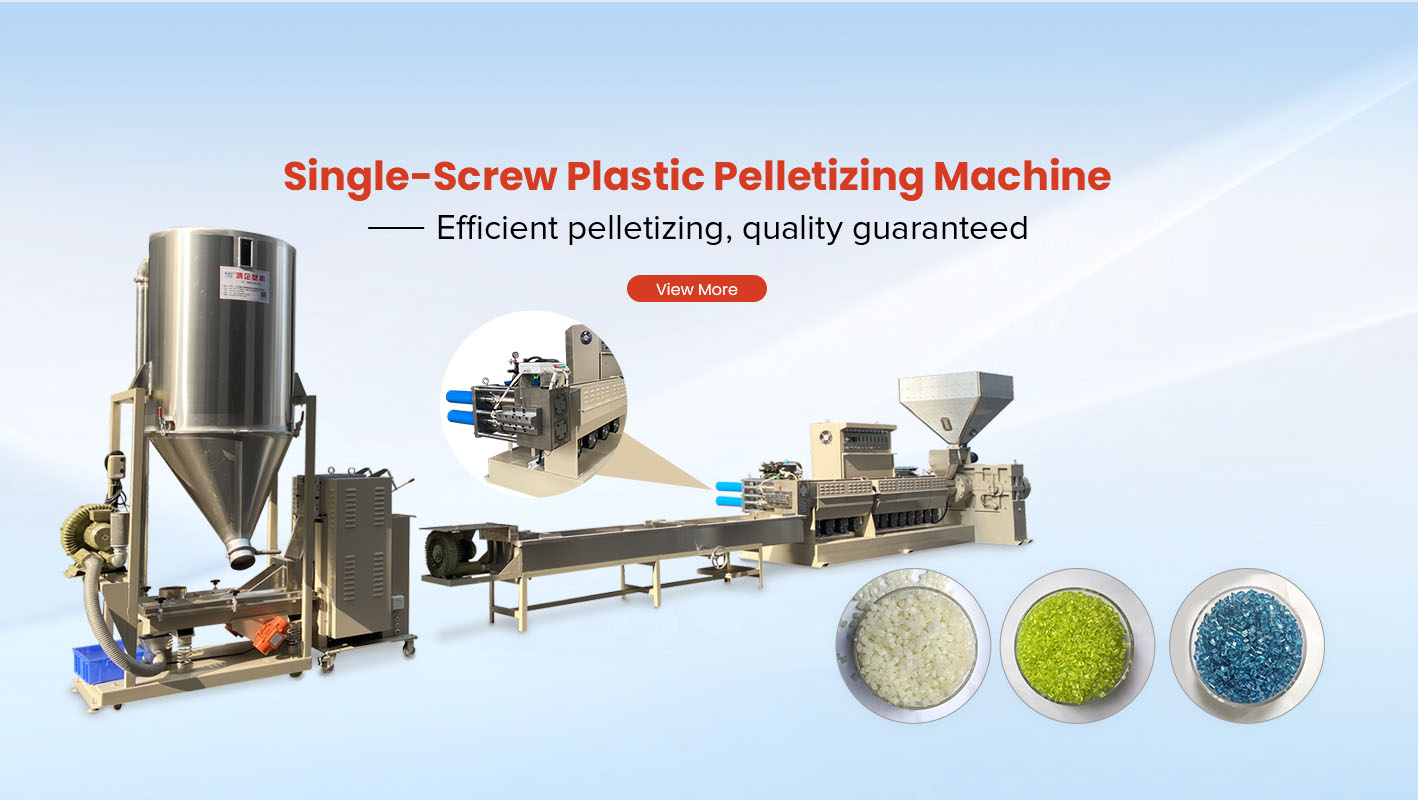
Single screw plastic pelletizing extrusion machine for stable melting and high-throughput recycling of relatively consistent materials
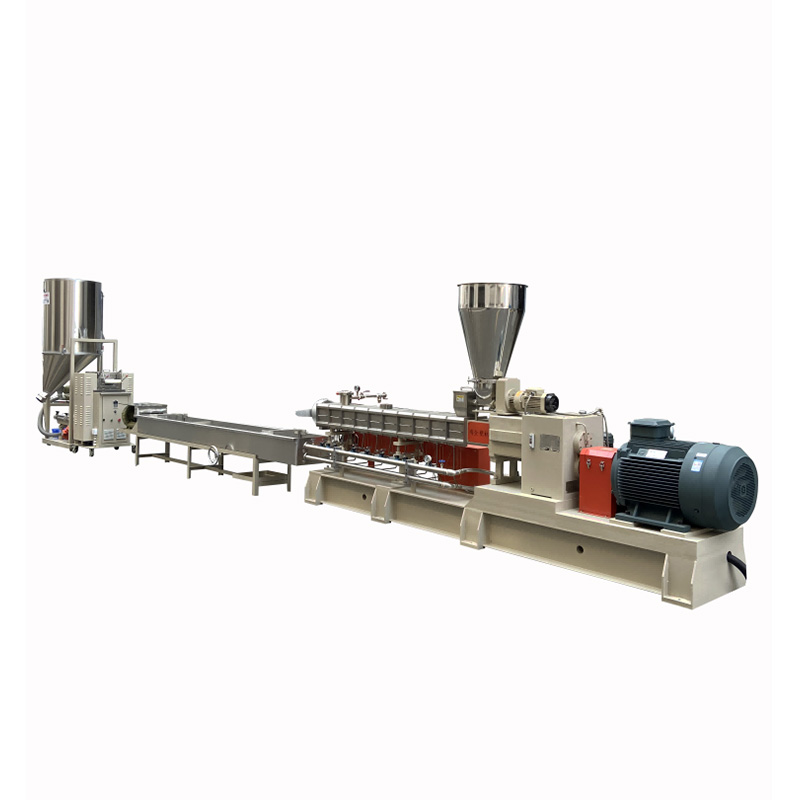
Twin screw plastic pelletizing extrusion machine for intensive mixing, compounding, and dispersion of fillers, additives, or reinforcements
A practical way to compare these routes is to focus on what the screw system must accomplish.
Single Screw Pelletizing For Stable High-Output Recycling
Single screw extrusion is typically selected when the material stream is relatively consistent and the priority is stable melting and efficient throughput. HONGQI’s single screw pelletizing equipment is configured to support efficiency at the line level, not only at the extruder barrel:
A stable drive configuration using a core motor and inverter set helps keep screw speed steady during load changes, which supports higher average output during long runs.
In-house screen changer manufacturing helps reduce filtration-related downtime and shortens pressure recovery after screen changes.
A water-cooling pelletizing mode improves heat removal and supports steady pellet formation when output increases.
CNC machining capability strengthens dimensional control for key components, which supports sealing accuracy and stable melt pressure.
For capacity planning, single screw pelletizing equipment in HONGQI’s lineup includes high-output configurations such as HQ-150 with a reference output range of 600–900 kg/h, and HQ-120 with a reference output range around 380–550 kg/h, depending on material and setup.
Twin Screw Pelletizing For Compounding, Masterbatch, And High-Fill Materials
Twin screw extrusion is commonly used when you need strong mixing and controlled dispersion, such as masterbatch production, engineering plastics modification, elastomers, and highly filled compounds. The co-rotating twin screw design can deliver more uniform blending of additives and fillers, and support stable compounding quality at industrial scale.
HONGQI’s twin screw pelletizing models provide reference outputs that cover mid to higher production ranges:
HQ-52C: about 260–350 kg/h with 10-zone temperature control
HQ-65B: about 380–600 kg/h with 10-zone temperature control
HQ-75B: about 450–700 kg/h with 10-zone temperature control
For B2B buyers evaluating compounding lines, these figures are most useful when combined with the planned formulation complexity, filler loading, and degassing requirements, because these factors determine whether output is limited by mixing, filtration, or cooling.
How To Choose The Right Extrusion Type And Equipment For Your Project
Selecting among different plastic extrusion types becomes much easier when you map the product goal to the process constraints. The table below provides a project-oriented comparison.
| Extrusion Type | What It Produces | Process Bottleneck | Best When You Need |
|---|
| Profile extrusion | Continuous shaped profiles | Calibration and cooling stability | Dimensional control and consistent surface finish |
| Sheet extrusion | Thick flat sheet | Gauge control and roll cooling | Flatness, thickness uniformity, stable roll stack operation |
| Film extrusion | Thin film | Melt stability and thickness control | High-speed production with low defect tolerance |
| Pipe/tubing extrusion | Pipes and tubes | Sizing, cooling, ovality control | Pressure-grade consistency and wall thickness stability |
| Parison extrusion for blow molding | Parison for hollow parts | Melt strength and thickness programming | Stable molding cycles and low scrap rate |
| Coating extrusion | Coated substrate layers | Melt cleanliness and adhesion control | Defect control and stable coating thickness |
| Pelletizing extrusion | Pellets for reuse | Filtration, cooling, pellet cutting | Stable output, consistent pellet quality, long continuous runs |
When your target is recycling or compounding pellets, the next decision is single screw vs twin screw. The table below is a practical selection guide.
| Decision Factor | Single Screw Pelletizing Extrusion | Twin Screw Pelletizing Extrusion |
|---|
| Material consistency | Better when feedstock is relatively consistent | Better when formulation varies or needs intensive blending |
| Mixing requirement | Moderate mixing | Strong mixing and dispersion for additives and fillers |
| Typical use cases | Recycling, reprocessing, stable melt delivery | Compounding, masterbatch, engineering plastics modification |
| Efficiency lever | Stable drive + filtration uptime + pelletizing stability | Mixing quality + temperature profile + degassing stability |
For customers building a scalable line, HONGQI supports customization at the system level rather than only swapping a single component. That includes configuring the drive system, matching filtration strategy, and aligning pelletizing and cooling capacity to the real production target. This approach fits solution provider purchasing logic where the goal is long-term stable operation, not only initial commissioning performance.
Conclusion
Different types of plastic extrusion exist because different products impose different stability limits: sizing for pipes, gauge for film, adhesion for coating, or mixing for compounding. For recycling and granulation projects, pelletizing extrusion is often the most flexible route because it converts mixed inputs into standardized pellets.
If your priority is stable, high-throughput recycling with strong uptime performance, a Single Screw Plastic Pelletizing Extrusion Machine is typically the most direct path. If your project requires strong mixing and dispersion for masterbatch, high-fill compounds, or engineered formulations, a Twin Screw Plastic Pelletizing Extrusion Machine is often the better fit. For commercial-grade production, the final efficiency result depends on how the drive system, filtration, machining precision, and pelletizing cooling mode work together as one line.