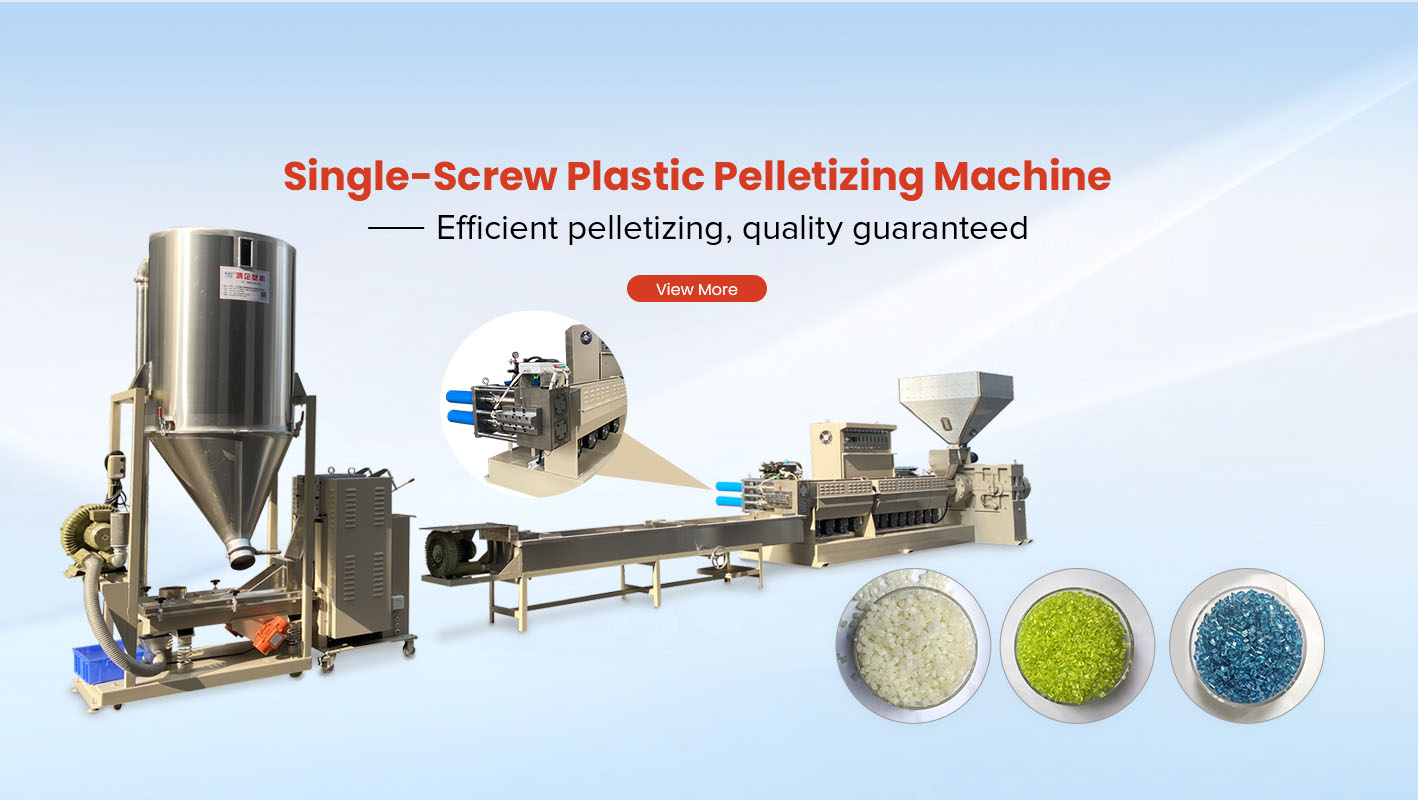
Plastic pellets are the foundation of modern plastics manufacturing. Nearly every molded, extruded, or processed plastic product—ranging from household items to high-performance engineering components—begins as uniform resin pellets. These pellets offer stable handling, consistent melt flow, and high production efficiency, making them the preferred form for large-scale industrial processing. Understanding how plastic pellets are made helps explain how the qualities of the final product are controlled at every stage.
For factories using advanced pelletizing lines and Auxiliary Equipment, HONGQI provides a comprehensive range of solutions, including Single Screw Plastic Pelletizing Extrusion Machine, Twin Screw Plastic Pelletizing Extrusion Machine, Strand Pelletizers, and various mixers and dewatering systems, all available through our product range.

How Plastic Pellets Are Made
The pelletizing process transforms raw plastic—whether virgin resin, recycled waste, or modified composite—into uniform, transportable pellets through controlled heating, mixing, extrusion, cooling, and cutting. While the specific process differs depending on material type, the overall steps are similar. Below is a detailed look at how plastic pellets are produced in an industrial environment.
1. Raw Material Preparation
The first step involves gathering and preparing the plastic feedstock. Virgin granules, flakes, powders, or recycled shredded materials must be cleaned, dried, and sometimes pre-mixed with additives such as stabilizers, pigments, fillers, or reinforcements.
Industrial mixers—such as vertical mixers and color mixers—ensure that dry materials achieve uniform composition before extrusion. A well-blended mixture improves melt consistency and ultimately enhances pellet quality.
2. Feeding Into the Extrusion System
Once prepared, the material is fed into a single-screw or twin-screw pelletizing extrusion machine. Feeding is typically controlled by a Screw Conveyor or automatic loader to maintain stable throughput.
In the extruder, the screws convey material forward while applying heat and shear. The plastic transitions from solid to molten state through a carefully controlled temperature profile. Twin-screw systems provide superior dispersion and mixing, making them ideal for compounding additives or producing high-performance engineering materials.
HONGQI’s extrusion systems are designed to maintain stable melting performance, even with recycled or multi-component materials.
3. Melting, Mixing, and Homogenizing
Inside the extruder, the plastic undergoes melting and intense mechanical mixing. Twin-screw systems generate powerful kneading action, ensuring that every component—resin, filler, pigment, or reinforcement—is dispersed uniformly into the melt.
During this stage, pressure builds and pushes the molten material toward the die head. Maintaining consistent melt pressure and temperature ensures that pellets will later have uniform shape and density.
4. Extrusion Through the Die
The molten polymer is forced through a die plate that shapes it into strands or directs it into underwater pelletizing chambers. The design of the die significantly affects strand stability and pellet uniformity.
Different pelletizing approaches include:
Strand pelletizing, where molten strands exit the die and are cooled before cutting
Underwater pelletizing, where pellets are cut directly at the die face while submerged
Water-ring pelletizing, where cutters rotate around the die plate in a controlled water flow
HONGQI offers equipment capable of supporting strand pelletizing lines, ensuring smooth extrusion and strand stability even at high output.
5. Cooling the Extrudate
The cooling stage stabilizes the molten polymer into solid form.
For strand pelletizing, strands pass through a water trough or an air-cooling channel. Their integrity must remain intact until reaching the pelletizer.
For underwater pelletizing, cooling happens instantly in a submerged chamber, allowing high-volume production of spherical pellets.
Correct cooling prevents deformation, sticking, or internal defects.
6. Cutting Into Pellets
After cooling, strands enter a pelletizer where rotating knives slice them into uniform lengths. HONGQI’s strand pelletizers are engineered for stability, maintaining clean, consistent cuts at high operating speeds.
In underwater systems, cutters mounted directly on the die face chop molten polymer instantly, producing highly consistent spherical pellets.
The cutting mechanism determines the final pellet shape, size, and flow characteristics.
7. Dewatering and Drying
Pellets produced through water-cooled or underwater methods require thorough drying. A centrifugal dewatering machine rapidly removes water from the surface of the pellets, followed by an air dryer that removes remaining moisture.
Effective drying ensures pellets do not clump or degrade during storage.
8. Screening and Quality Sorting
Pellets then pass through a vibrating screen to remove oversized pieces, dust, or irregular particles. Only uniform pellets move forward to packaging.
HONGQI’s linear vibrating screen machines help ensure grading accuracy and stable output quality.
9. Final Packaging and Storage
Once screened and dried, pellets are packed in bags, super-sacks, or containers for transport. Pellets are easy to handle, meter, and feed into downstream processing equipment, making them an ideal material form for injection molding, extrusion, blow molding, or compounding applications.
Summary of Key Steps
| Stage | Description | Equipment Often Used |
|---|
| Raw material prep | Cleaning, drying, mixing | Plastic mixers, vertical mixers |
| Feeding | Controlled feeding into extruder | Screw conveyor |
| Melting & mixing | Thermal and mechanical homogenizing | Single/twin-screw pelletizing machines |
| Extrusion | Molten polymer exits die | Pelletizing extrusion machine |
| Cooling | Stabilizing shape | Water trough, cooling system |
| Cutting | Forming pellets | Strand pelletizer |
| Drying | Water removal | Centrifugal dewater machine |
| Screening | Removing irregular pellets | Vibrating screen machine |
Common Questions About Plastic Pellet Production (Based on Customer Needs)
“Which pelletizing system should I choose?”
Strand pelletizing is ideal for most thermoplastic materials, recycled materials, and compounding lines. Underwater pelletizing is preferred for high output or materials that cannot form stable strands. Many customers select HONGQI’s strand pelletizer because it offers high stability, easy maintenance, and clean cutting.
“Can your equipment handle recycled plastics?”
Yes. HONGQI pelletizing machines are designed for both virgin and recycled materials. With proper feeding and mixing, recycled flakes or regrinds can be consistently pelletized.
“How do I choose between single-screw and twin-screw extrusion?”
Single-screw systems are excellent for stable materials and general-purpose recycling.
Twin-screw systems offer better mixing and dispersion, ideal for masterbatch, composite materials, and engineering plastics.
“Is maintenance complicated?”
Most auxiliary equipment—mixers, conveyors, vibrators, dewatering machines—is easy to maintain. Strand pelletizers require knife replacement and occasional alignment adjustments. HONGQI designs machines with accessible structures to simplify routine maintenance.
“What capacity can your pelletizing lines achieve?”
Capacity varies by model and material type. HONGQI offers multiple configurations for small, medium, and large-scale production, ensuring flexibility for different factory sizes.
“Can your pelletizing line be customized?”
Yes. Complete customization of screw designs, die structures, pelletizer types, and auxiliary equipment integration is available according to customer requirements.
Summary
Plastic pellets are made through a systematic process involving melting, mixing, extrusion, cooling, cutting, drying, and screening. Each stage plays a crucial role in determining pellet quality and consistency. With reliable equipment—such as pelletizing lines, mixers, pelletizers, dewatering machines, and conveyors—manufacturers can achieve stable production, uniform pellet size, and high throughput.
HONGQI offers a full range of pelletizing machinery and auxiliary systems that support complete pellet production solutions. With more than 20 years of industry experience, the company focuses on performance, precision, and ease of operation, providing equipment trusted by plastic processors worldwide.