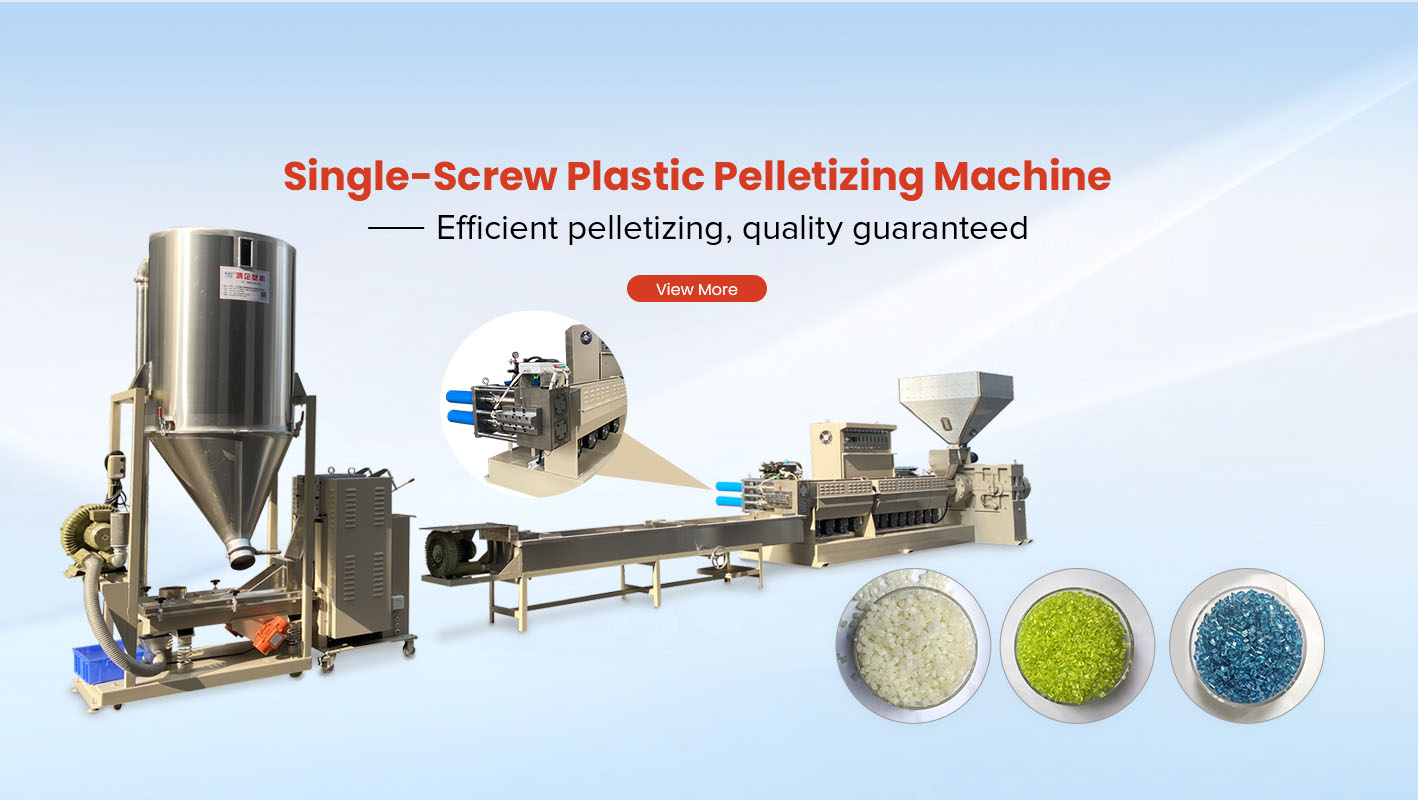
Twin screw extruders have become the core equipment in modern plastics processing, polymer compounding, masterbatch manufacturing, biomass modification, chemical blending, and advanced material development. Compared with single screw technology, the twin screw design introduces a fully intermeshing, co-rotating system that dramatically improves mixing efficiency, dispersion capability, heat transfer, and process stability. This makes it the preferred choice in industries requiring high-precision compounding or complex formulations. Whether the production goal is to disperse additives, modify polymers, incorporate fillers, or create high-performance engineering materials, a twin screw extruder provides the consistent and controllable shear environment necessary to achieve reliable output.
HONGQI’s Twin Screw Plastic Pelletizing Extrusion Machine is engineered for high torque, efficient compounding, and stable long-term operation. To understand why industries rely on twin screw systems, it is important to examine the specific advantages they offer compared with traditional extrusion methods.
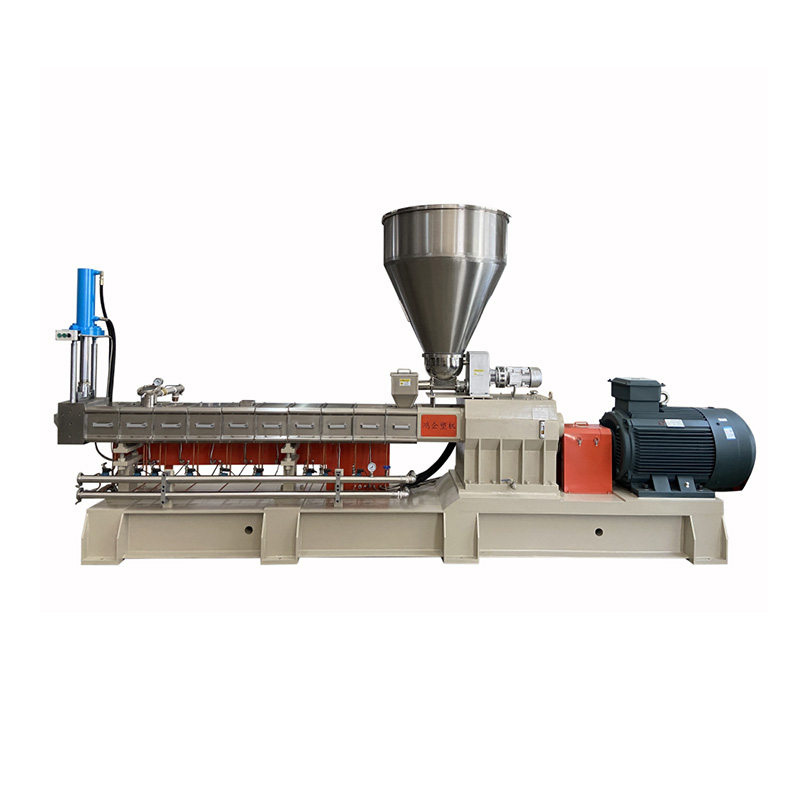
1. Superior Mixing Performance Through Intermeshing Screw Design
The first reason manufacturers choose a twin screw extruder is its exceptional mixing ability. Two screws rotating together allow material to be continuously transferred between screw channels, creating a dynamic combination of distributive and dispersive mixing. This internal action ensures additives, pigments, fillers, and polymers are blended uniformly.
Unlike single screw extruders—where mixing depends primarily on shear in the compression zone—a twin screw extruder provides consistent mechanical energy throughout the barrel, enabling stable homogenization even with challenging materials such as glass fiber, flame retardants, wood-plastic composites, and heavily filled compounds.
Advantages of Intermeshing Twin Screw Mixing
Continuous material exchange between screws
Uniform temperature distribution
Controlled shear energy for stable melting
Strong dispersive ability to break down agglomerates
Excellent filler incorporation efficiency
These characteristics allow industries to achieve consistent output quality, especially when manufacturing masterbatch, color concentrates, and engineering polymer compounds.
2. Greater Process Flexibility for Complex Formulations
Another major advantage of twin screw extruders is their ability to handle wide-ranging formulations. Modern plastics and composite materials require precise integration of multiple ingredients—reinforcing agents, compatibilizers, stabilizers, mineral fillers, colorants, and recycled fractions. Many of these ingredients behave differently under heat and pressure, and a single screw extruder often lacks the flexibility to process them efficiently.
Twin screw systems offer multiple feeding positions along the barrel, enabling processors to introduce materials at optimal locations based on their thermal sensitivity and melting characteristics. For example, heat-sensitive agents can be added downstream to prevent degradation, while fillers can be introduced via side feeders to avoid system overload.
Typical Material Categories Ideal for Twin Screw Processing
| Material Type | Why Twin Screw Works Better |
|---|
| Engineering Plastics | Requires precise melting and high shear |
| High-Fill Compounds | Needs strong dispersive power |
| Recycled Materials | Requires stable melting and venting |
| Wood-Plastic Composites | Demands controlled temperature |
| Adhesive Compounds | Needs intensive mixing |
| Rubber / Elastomers | Sensitive to thermal variation |
hongqi twin screw extruders allow customized screw configurations to tune shear level, mixing intensity, and residence time based on the specific formulation.
3. Higher Output Efficiency and Consistent Feeding Stability
Twin screw extruders do more than improve mixing—they significantly enhance throughput efficiency. Because intermeshing screws create a self-wiping effect, material cannot stagnate and degrade. This mechanism also minimizes pressure fluctuations, reduces torque spikes, and ensures smooth feeding.
The self-wiping action prevents material buildup, which leads to cleaner melt and longer production cycles without shutdown interruptions. Combined with high torque gearboxes and precise speed control, twin screw systems can achieve stable output even with difficult materials.
Operational Efficiency Benefits
Reduced stagnation and carbonization
Stable torque across varying loads
Faster melting due to efficient heat transfer
Improved feeding consistency
High throughput per hour
Twin screw extruders generate more kilograms per hour at lower specific energy consumption (SEC), directly improving production cost efficiency.
4. Enhanced Degassing, Venting, and Moisture Removal for Recycled Materials
As global manufacturing increases its use of recycled plastics, the demand for effective degassing and impurity removal has grown. This is another reason twin screw extruders are preferred: they provide superior venting performance.
Because the material is continuously redistributed between the two screws, surface renewal is constant. This exposes more material to vacuum vents, enabling moisture, residual solvents, volatiles, and trapped gases to escape efficiently. This is especially critical for:
PET, PA, and ABS recycling
Wood-plastic composites
VOC-contaminated materials
Industrial scrap pelletizing
Filling and reinforcing compounds
Degassing Comparison Table
| Feature | Twin Screw Extruder | Single Screw Extruder |
|---|
| Number of Vent Zones | Multiple vents possible | Usually one |
| Surface Renewal Rate | Very high | Moderate |
| Moisture Removal | Excellent | Limited |
| VOC Stripping | High efficiency | Low efficiency |
HONGQI twin screw systems adopt large-volume vacuum chambers and optional double-vent designs to deliver stable processing even with high-moisture recycled materials.
5. Greater Customization Through Modular Screw and Barrel Design
One of the defining features of twin screw extruders is their modularity. Screw Elements—including conveying blocks, kneading discs, mixing elements, and reverse-pressure segments—can be rearranged to create a customized process path. This modularity allows the machine to be tailored to the specific rheology, melting characteristics, and mixing needs of each polymer.
This is not simply an advantage—it fundamentally changes the way manufacturers design extrusion lines. Instead of forcing different materials through a fixed screw configuration, processors can design the ideal screw geometry to achieve targeted compound properties.
Benefits of Modular Design
Adjustable shear level
Customizable residence time
Tunable mixing intensity
Flexible process transitions
Optimized melting or pressure buildup
With this flexibility, manufacturers can use a single HONGQI twin screw extruder to produce multiple product types by simply changing the screw configuration.
6. Reliable Performance for Modern Industrial Production and Long-Term Cost Efficiency
Ultimately, companies choose twin screw extruders not only for performance advantages but also for long-term economic value. A twin screw system reduces per-ton processing energy, minimizes batch inconsistency, lowers material waste, and delivers predictable output quality. All these benefits translate into lower production cost per kilogram and fewer machine stoppages.
Manufacturers appreciate that twin screw technology enables continuous, stable operation with minimal labor intervention. The precision of temperature control, torque monitoring, and automated feeding systems further improves reliability. For industries producing engineering plastics, TPE/TPV materials, masterbatch, or recycled pellets, these advantages directly impact competitiveness.
Summary of Key Advantages
| Benefit | Explanation |
|---|
| High Mixing Quality | Uniform distribution of additives and fillers |
| Strong Shear Control | Ideal for complex compounds |
| Superior Degassing | Essential for recycled materials |
| Higher Output Stability | Smooth feeding and pressure control |
| Modular Flexibility | Adaptable to many applications |
| Lower Energy Cost per Ton | Efficient torque and melting |
HONGQI’s Twin Screw Plastic Pelletizing Extrusion Machine embodies these strengths through advanced screw geometry design, strong torque systems, and efficient temperature control—making it a reliable choice for factories seeking long-term consistency and high-performance compounding.
Conclusion
Twin screw extruders outperform traditional extrusion technology by delivering superior mixing, greater formulation flexibility, stronger degassing capability, stable output efficiency, and long-term cost advantages. Their modular design and precise control capabilities make them the preferred choice for advanced polymer processing, masterbatch production, recycled pelletizing, and materials requiring controlled shear conditions.
For manufacturers looking to improve product quality, increase throughput, and ensure long-term production stability, adopting a twin screw extruder is a strategic investment. HONGQI provides high-efficiency twin screw systems engineered to meet the demands of modern material manufacturing, offering precise compounding capability and durable mechanical performance that support industrial growth.