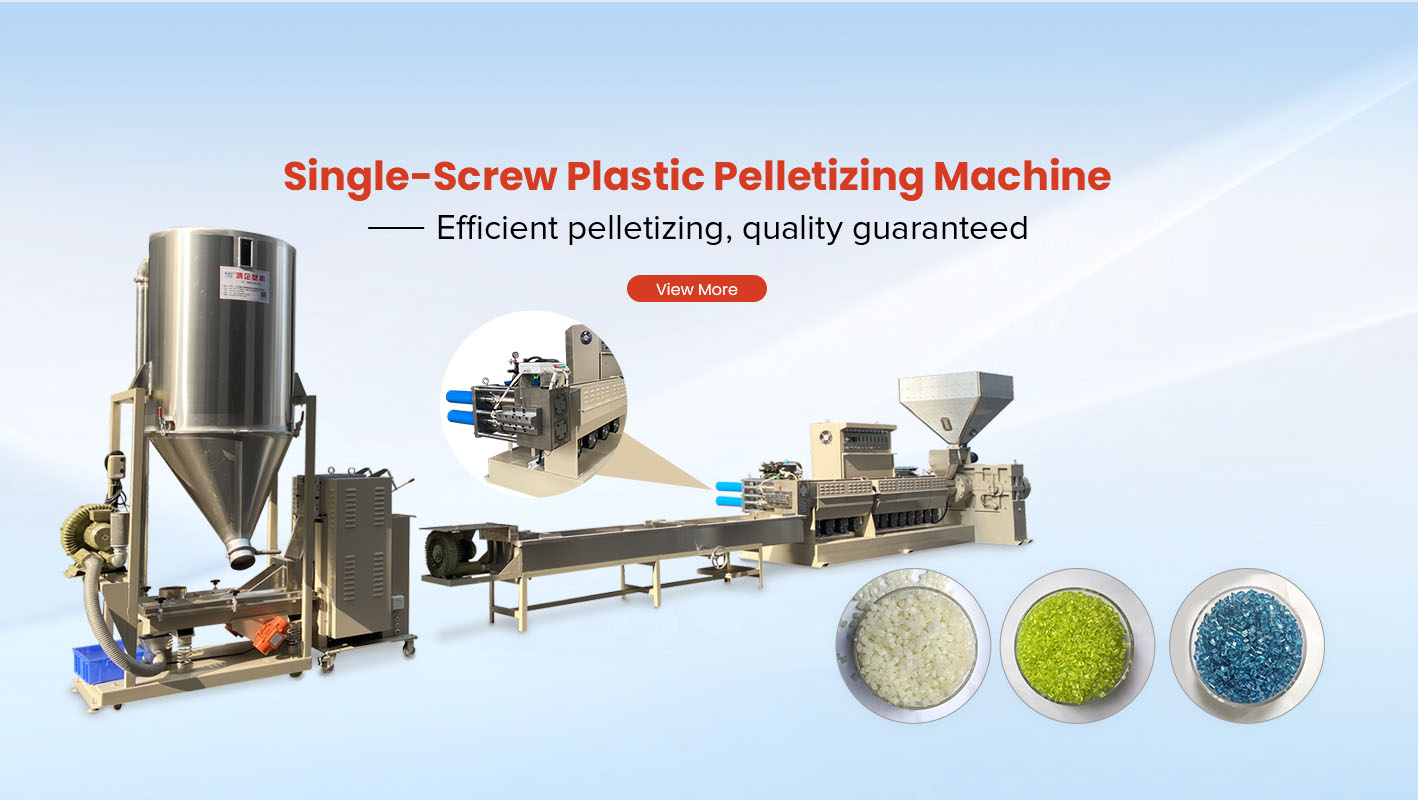
For small recycling plants, the core challenge is not whether plastic can be pelletized, but whether pelletizing can be done stably, economically, and with predictable quality under limited manpower, space, and capital investment. A single screw plastic pelletizing extrusion machine is widely adopted in small and medium recycling operations precisely because it addresses these constraints directly. When properly designed and configured, this type of equipment becomes a practical production tool rather than a complex system that requires constant adjustment.
This article focuses on how single screw plastic pelletizing extrusion machines support small recycling plants in real production, what concrete advantages they bring, and what economic and operational benefits they can deliver. If you need to learn more about system structures and available configurations, please browse our single screw plastic pelletizing extrusion machine page.
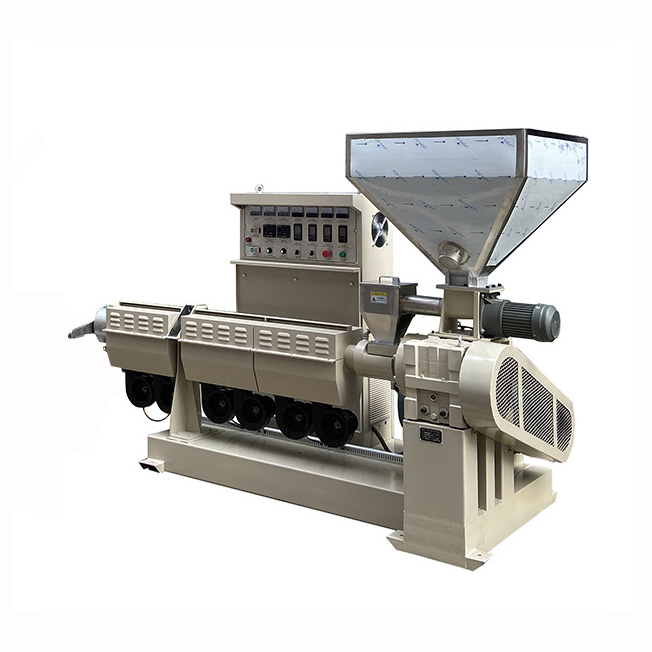
Stable Output That Matches Small-Plant Operating Reality
Small recycling plants often run batch-based production instead of 24-hour continuous operation. Material sources may vary by day, and production schedules are adjusted around labor availability and incoming waste volume. Under these conditions, equipment stability matters more than extreme capacity.
A single screw plastic pelletizing extrusion machine supports this reality by providing stable melt conveying and predictable pressure behavior. The single screw structure offers a continuous and linear melting process, which helps maintain consistent strand formation even when material input fluctuates within a reasonable range. This stability reduces strand breakage, uneven pellet size, and sudden shutdowns that can easily disrupt small operations.
Because operating parameters such as screw speed, barrel temperature, and melt pressure are easy to monitor, operators can quickly identify deviations without advanced process expertise. This lowers the operational threshold for small plants and reduces dependence on highly specialized technicians.
Lower Investment Pressure and Faster Return
Capital investment is a critical consideration for small recycling plants. A single screw plastic pelletizing extrusion machine provides a clear advantage by combining lower initial equipment cost with lower long-term operating expenses. Compared with more complex extrusion systems, the single screw design has fewer mechanical components, simpler transmission structures, and lower maintenance requirements.
From an economic perspective, this translates into:
Reduced initial investment burden
Lower Spare Parts and maintenance costs
Shorter learning curve for operators
Faster commissioning and earlier production start
For many small plants, this means the pelletizing line can begin generating cash flow sooner, improving overall return on investment and reducing financial risk during the early stages of operation.
Pellet Quality Improvement That Increases Selling Value
Small recycling plants often struggle to move beyond low-value regrind sales due to inconsistent material quality. A single screw plastic pelletizing extrusion machine helps address this by converting flakes, crushed materials, or powders into uniform pellets with consistent geometry and density.
Stable extrusion pressure and controlled melting behavior support:
These improvements directly increase pellet usability for downstream processes such as injection molding or extrusion, allowing small plants to access a broader customer base and command better pricing. Instead of competing purely on volume, small recyclers gain the ability to compete on quality consistency.
Adaptability to Common Recycling Materials
Most small recycling plants focus on relatively common plastic streams such as PP, PE, PET, ABS, PC, or pmma. Single screw plastic pelletizing extrusion machines are well suited for these materials because their melting behavior is predictable and does not require intensive distributive mixing.
With appropriate screw design and temperature zoning, a single screw system can process a wide range of recycled plastics in forms including flakes, crushed scraps, and granules. This versatility allows small plants to handle different material batches without investing in multiple dedicated lines.
Technical configurations such as different screw diameters, L/D ratios, and heating zone layouts allow output capacity to scale from small workshop-level production to higher throughputs as the business grows :contentReference[oaicite:0]{index=0}.
Reduced Maintenance Burden and Downtime Risk
Maintenance capability is often limited in small recycling plants. Equipment that requires frequent disassembly or specialized servicing increases downtime risk and operational stress. Single screw plastic pelletizing extrusion machines are favored in this environment because of their simple mechanical layout and accessible maintenance points.
Routine tasks such as:
can be completed with standard tools and basic technical training. This minimizes reliance on external service teams and helps keep production schedules predictable. Over time, predictable maintenance also reduces unexpected repair costs that can heavily impact small operations.
Energy Efficiency That Controls Production Costs
Energy consumption is a significant operating expense for recycling plants. Single screw plastic pelletizing extrusion machines are inherently energy-efficient due to their direct melting and conveying mechanism. When paired with modern motors, inverters, and optimized heating systems, energy use per ton of output can be kept under control.
Lower specific energy consumption means:
Reduced electricity cost per kilogram of pellets
Less heat-related material degradation
Improved thermal stability during long runs
For small plants operating on tight margins, this efficiency helps stabilize production costs and improve profitability even when market prices fluctuate.
Scalable Configuration for Gradual Growth
Small recycling plants rarely expand in a single step. Growth usually comes through gradual improvements in sorting, washing, drying, and downstream processing. A single screw plastic pelletizing extrusion machine fits well into this development path because it can serve as a stable core system while upstream processes are upgraded over time.
As material cleanliness improves, the same pelletizing line can:
Run at higher throughput
Produce higher-grade pellets
Reduce screen change frequency
Improve overall line efficiency
This scalability allows small plants to invest progressively rather than replacing equipment prematurely.
Practical Production Benefits in Daily Operation
In day-to-day use, the value of a single screw plastic pelletizing extrusion machine lies in how well it supports routine production rather than theoretical performance limits. For small recycling plants, the key benefits include:
Stable and predictable pellet output
Simplified operation with minimal training requirements
Lower capital and operating costs
Improved pellet quality and market acceptance
Reduced downtime and maintenance complexity
HONGQI designs single screw plastic pelletizing extrusion machines with a strong focus on reliability, energy efficiency, and practical recyclability, ensuring that small recycling plants can achieve consistent production results under real-world conditions. For more details on available models and system configurations, please browse our single screw plastic pelletizing extrusion machine page.
Conclusion
Single screw plastic pelletizing extrusion machines are highly suitable for small recycling plants because they align closely with the operational, financial, and technical realities of small-scale recycling. By offering stable extrusion behavior, manageable investment cost, improved pellet quality, and low maintenance complexity, these machines help small plants move from unstable regrind handling toward consistent, market-ready pellet production. Instead of increasing operational burden, they provide a reliable foundation that supports both immediate production needs and long-term business growth.