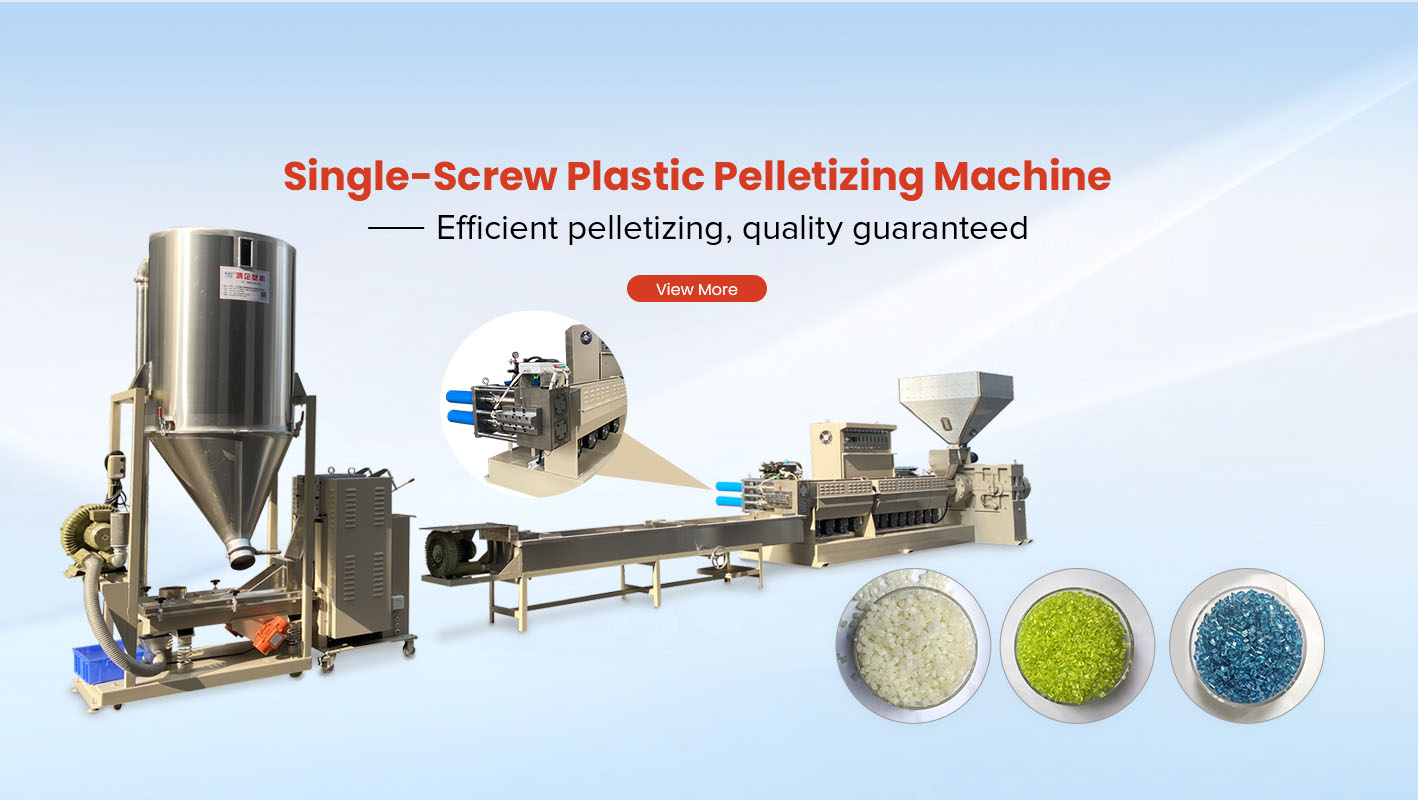
Plastic extrusion can be explained in five practical stages:
Preparing the material
Feeding and conveying
Melting and mixing
Filtering and forming
Cooling and finishing
These stages apply broadly to plastic extrusion, but the actual equipment changes according to whether the factory produces profiles, pipes, sheets, films, compounds, or recycled pellets.
For a recycling pelletizing line, the five-step model is especially useful because it shows where raw-material quality, machine settings, and downstream equipment affect the final granules.
Step 1: Prepare the Plastic Material
Extrusion begins before the plastic reaches the hopper.
The raw material should be identified, sorted, cleaned, and reduced to a suitable size. Recycled plastic may also require washing, dewatering, drying, and premixing.
Check These Material Conditions
| Item | Why It Matters |
|---|
| Resin type | Determines the processing-temperature range |
| Particle size | Influences feeding consistency |
| Moisture | Can cause bubbles and unstable output |
| Contamination | Affects filtration and pellet quality |
| Additives | Influence color and final properties |
| Bulk density | Affects hopper and feeder behavior |
A stable extrusion line cannot correct every problem caused by poorly prepared feedstock.
Separate Incompatible Plastics
PE, PP, PET, ABS, PC, PVC, and other polymers do not behave identically.
When mixed without a technical formulation, they may produce weak or inconsistent pellets. Sorting and material testing should be completed before equipment parameters are finalized.
Step 2: Feed and Convey the Material
The prepared plastic enters the hopper and is transported into the barrel by the rotating screw.
The feed rate should match the screw speed and the melting capacity of the machine.
Why Consistent Feeding Is Important
Uneven feeding can produce:
Film scrap and light flakes may require forced feeding, while regular pellets and dense regrind may flow through a standard hopper more easily.
Step 3: Melt and Mix the Plastic
The screw moves the material through controlled barrel zones.
The plastic is heated by the barrel heaters and by mechanical shear inside the screw and barrel. As it melts, the material is compressed, mixed, and homogenized.
Main Parameters to Watch
Operators normally monitor:
Zone temperatures
Screw speed
Motor current
Melt pressure
Feed rate
Cooling fans or water
Vacuum condition
Output appearance
The correct settings depend on the polymer and the required product. A temperature profile suitable for PP should not be copied directly to PET, PC, or another material.
Single-Screw Processing
A Single Screw Plastic Pelletizing Machine is commonly used for relatively consistent recycling materials and straightforward pellet production.
Its main strengths include a simple process layout, stable conveying, practical operation, and integration with feeding, filtration, cooling, and cutting equipment.
The screw design should still be selected according to the material’s bulk density, melt behavior, moisture, and required output.
Step 4: Filter and Form the Melt
Before the plastic leaves the extruder, it may pass through a screen changer.
This removes selected solid contamination and helps protect the pellet quality.
The filtered melt then passes through the die head.
Filtration Choices
The system may use:
Manual screen changing
Hydraulic screen changing
Dual-bolt continuous systems
Larger filtration areas for contaminated material
Finer screens can improve filtration, but they may also increase pressure and require more frequent changes.
Forming the Strands
For strand pelletizing, the die produces several continuous molten strands.
Uniform strand flow depends on stable feeding, even melting, clean screens, controlled die temperature, and balanced die holes.
Step 5: Cool and Finish the Output
The strands enter a water-cooling tank and solidify before cutting.
A Strand Pelletizer pulls the cooled strands forward and cuts them into granules. A vibrating screen may then separate long pieces, fines, and acceptable pellets.
Final Quality Checks
Inspect:
Pellet length
Pellet diameter
Cutting surface
Color
Dust level
Moisture
Bubbles
Mixed contamination
Storage temperature
The pellets should cool sufficiently before bagging. Packing hot or wet pellets can create condensation and storage problems.
The Five Steps Work as One System
A problem that appears at the cutter may have started much earlier.
For example:
Broken strands may come from contamination or unsuitable cooling.
Bubbles may come from moisture or poor degassing.
Uneven pellets may come from changing feed rate.
Black spots may come from degraded material or residue in the barrel.
High pressure may come from a blocked filter.
Troubleshooting should therefore follow the process from raw material to finished pellet rather than adjusting only the final machine.
Our Single-Screw Pelletizing Line Options
Our product range covers single-screw extrusion equipment with different screw sizes, output ranges, temperature-control zones, feeding systems, screen changers, and cooling arrangements.
The standard production line can be combined with automatic feeding, water cooling, strand cutting, vibrating separation, and pellet collection.
We also supply vertical and horizontal mixers, dewatering machines, Screw Conveyors, Strand Pelletizers, screens, and Spare Parts for a more complete recycling line.
Plan a Single Screw Plastic Pelletizing Machine Project
Provide the material name, photos, particle size, moisture, contamination, required hourly capacity, pellet target, available power, and plant dimensions.
We will recommend a Single Screw Plastic Pelletizing Machine and auxiliary-equipment arrangement based on the actual processing conditions.