pmma and PC are transparent thermoplastics, but they are selected for different performance priorities. PMMA provides excellent optical clarity, surface hardness, and outdoor weather resistance, while PC offers much higher impact strength, better heat resistance, and greater resistance to sudden breakage.
Neither material is universally better. The correct choice depends on whether the product needs maximum transparency, long-term outdoor appearance, impact protection, thermal stability, or controlled light diffusion.
PMMA and PC Are Different Polymer Families
PMMA stands for polymethyl methacrylate and is commonly called acrylic. It is valued for its clear appearance, gloss, color stability, and ability to transmit visible light.
PC stands for polycarbonate. It is an engineering thermoplastic known for toughness, dimensional stability, heat resistance, and resistance to impact.
Although both can be transparent, they have different molecular structures, melting behavior, drying requirements, processing temperatures, and degradation risks. They should not be mixed or processed under the same conditions without checking the formulation.
Optical and Surface Performance
Clear PMMA can provide very high light transmission and strong visual brilliance. It is widely used in signs, light guides, display covers, lighting panels, and decorative transparent components.
PMMA also has a relatively hard surface, which helps it resist light scratching during normal handling. Its outdoor weather resistance makes it suitable for products exposed to sunlight for long periods.
PC remains highly transparent, but its main advantage is not maximum clarity. Its stronger impact performance makes it suitable for protective covers, machine guards, transport components, electrical housings, and lighting products exposed to physical stress.
Untreated PC may require UV stabilization or a protective surface layer for long-term outdoor use. Its surface can also scratch more easily than PMMA.
Mechanical and Thermal Differences
PC is normally selected when the finished product may be dropped, struck, bent, or exposed to vibration. It can deform under impact instead of cracking immediately.
PMMA is more rigid and visually refined, but it is also more brittle. Sharp impact, incorrect drilling, or excessive assembly stress may cause cracking.
The main practical differences include:
Impact resistance: PC is significantly tougher.
Optical clarity: PMMA generally provides higher light transmission.
Surface hardness: PMMA normally resists scratching better.
Heat resistance: PC usually performs better at elevated temperatures.
Outdoor weathering: PMMA offers strong natural UV and weather resistance.
Fabrication: Both can be extruded, cut, drilled, and thermoformed, but processing conditions differ.
Cost: The final cost depends on resin grade, additives, thickness, and purchasing volume.
Which Material Works Better for LED Diffusers?
PMMA is often used when high light transmission, controlled diffusion, color stability, and long-term appearance are the main priorities.
PC is more suitable when the diffuser must resist impact, heat, transportation damage, or demanding installation conditions.
The final lighting result does not depend on the base polymer alone. Diffuser additives, masterbatch dosage, particle dispersion, sheet thickness, surface texture, LED spacing, and extrusion stability all affect brightness and hotspot control.
Poor mixing can create visible spots, color variation, uneven haze, or inconsistent transmission even when the correct polymer has been selected.
Processing PMMA and PC Scrap
Transparent recycling requires more control than ordinary mixed-plastic pelletizing. Moisture, excessive residence time, contamination, unstable temperature, and high shear can cause bubbles, yellowing, black spots, or changes in melt flow.
Our factory has more than 20 years of experience in plastic pelletizing machinery and supplies equipment for engineering plastics, transparent polymers, recycling, compounding, and granulation.
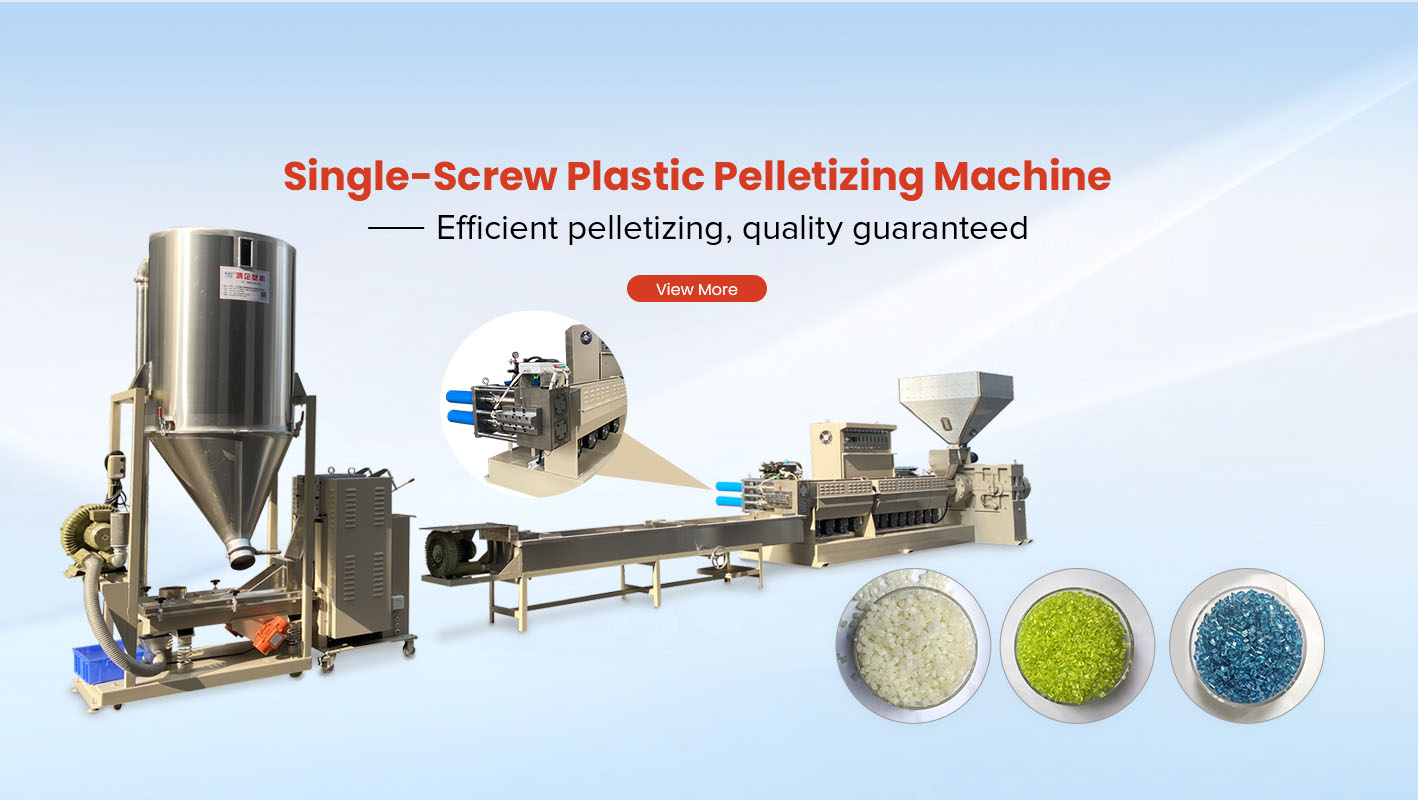
As a Reliable Export Supplier of PC and PMMA pelletizing machines, we provide single-screw, twin-screw, and two-stage pelletizing systems together with mixers, de-coating machines, dewatering equipment, conveyors, pelletizers, and vibrating screens.
Our PC and PMMA granulator configurations can be adjusted according to:
Material form and contamination level
Required output
Screw diameter and L/D ratio
Temperature-control zones
Screen-changing method
Cooling and cutting system
Available factory space
Finished pellet requirements
Request a PMMA or PC Processing Solution
Send our team the resin type, scrap form, moisture level, additive content, target output, pellet size, and current production problem.
We can review whether a single-screw, twin-screw, or two-stage line is more suitable and prepare a quotation covering equipment configuration, technical drawings, production, installation guidance, operator training, Spare Parts, and after-sales support.