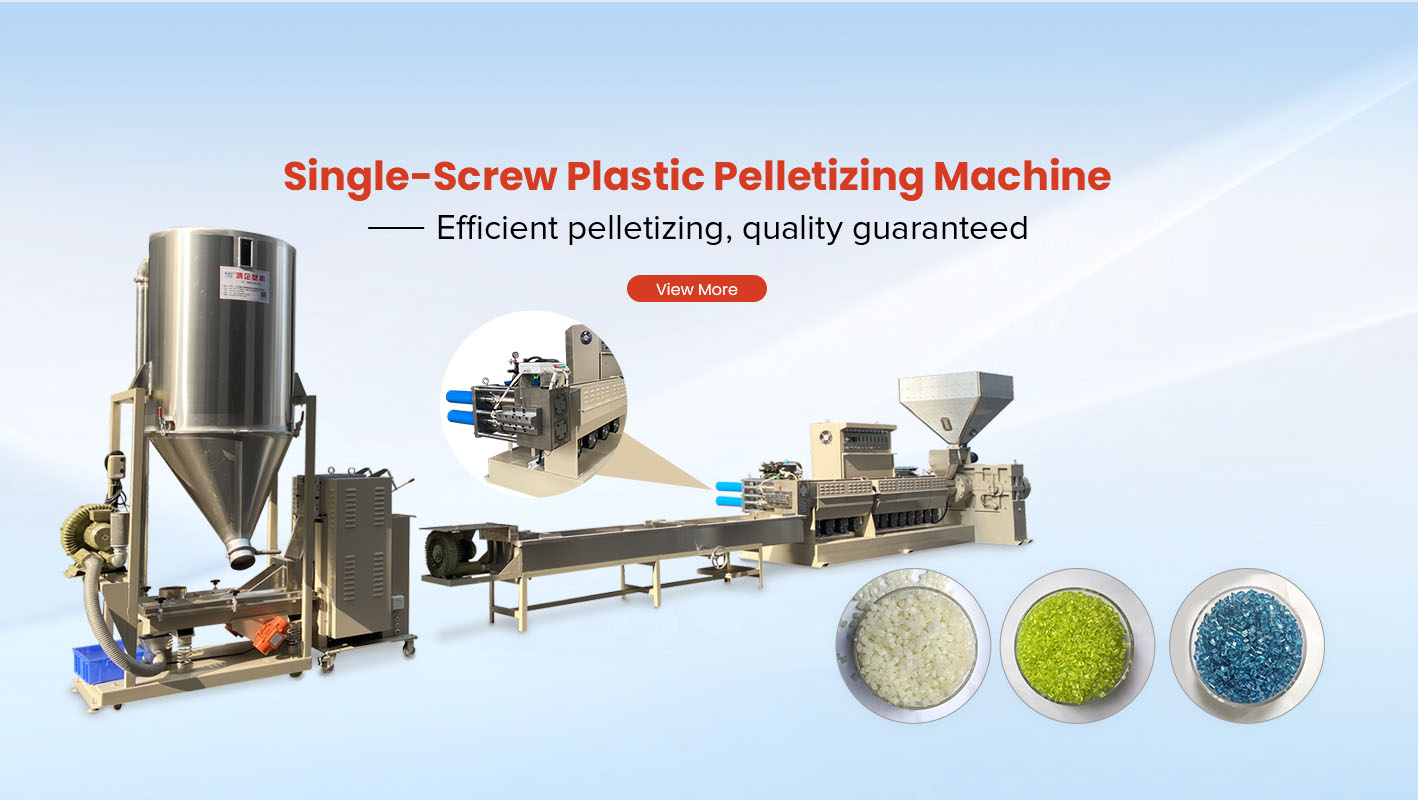
A single screw extruder uses one rotating screw to convey, melt, pressurize, and extrude plastic. A twin screw extruder uses two interacting screws, providing stronger mixing, more flexible material conveying, and better control when additives, fillers, pigments, or several polymers must be compounded.
Single screw equipment is often preferred for straightforward recycling and stable formulations. Twin screw equipment is usually selected for intensive compounding, devolatilization, reactive processing, and formulations requiring more uniform dispersion.
How a Single Screw Extruder Works
A single screw rotates inside a heated barrel. Material enters through the hopper and moves through feeding, compression, melting, metering, and discharge sections.
Its main strengths are:
Simple mechanical structure
Easier operation and maintenance
Lower initial equipment complexity
Stable continuous output
Efficient processing of relatively uniform materials
Lower energy and spare-parts requirements in suitable applications
Single screw pelletizers are commonly used for PE, PP, PS, ABS, PC, pmma, PET, and other thermoplastics when the material has already been sorted and does not require intensive additive dispersion.
They are also useful for transparent-plastic recycling because a properly designed screw can limit unnecessary mixing and residence time.
How a Twin Screw Extruder Works
Twin screw extruders use two screws operating inside the same barrel. Depending on the design, the screws may rotate in the same or opposite directions and may be intermeshing or non-intermeshing.
Segmented Screw Elements can be arranged to create conveying, kneading, mixing, venting, and pressure-building zones.
Twin screw systems are commonly used for:
Color masterbatch
Filler masterbatch
Glass-fiber compounds
Flame-retardant formulations
Polymer blends
High filler loading
Reactive extrusion
Material requiring vacuum degassing
Formulations with several additives
The self-wiping and controlled mixing action of many co-rotating twin screw systems helps reduce dead zones and distribute additives more uniformly.
Which Extruder Is Better for Recycling?
The answer depends on the incoming waste and required pellet.
A single screw system is suitable when the plastic is well sorted, relatively clean, and already has a consistent formulation. It can provide an economical route for converting flakes, runners, or production scrap into reusable pellets.
A twin screw system becomes more useful when the recycled material requires:
Mixing with virgin resin
Color correction
Filler addition
Compatibilizers
Stabilizers
Odor or volatile removal
Reinforcement
Property modification
Highly contaminated, printed, wet, or coated waste may also require washing, de-coating, drying, filtration, or a two-stage extrusion arrangement before acceptable pellets can be produced.
Output Is Not the Only Selection Factor
Machine buyers often compare extruders only by hourly capacity. Output is important, but it does not describe pellet quality or operating cost.
A complete evaluation should include:
Oversizing an extruder can increase material residence time and energy use when the feed rate is unstable. Undersizing it may cause continuous operation near the maximum load and reduce production flexibility.
Our Single and Twin Screw Equipment Range
As an Industrial Equipment Supplier for plastic pelletizing lines, our factory provides single-screw, twin-screw, two-stage, washing, mixing, de-coating, dewatering, conveying, cooling, cutting, and screening equipment.
Our published single-screw range can be configured for outputs from approximately 100 to 800 kg/h, depending on the model and material. Twin screw systems can be developed for approximately 150 to 2,000 kg/h with customized screw design, motor power, temperature zones, vacuum units, and control systems.
Our support includes:
Material and capacity analysis
Complete line configuration
Workshop layout
CNC-machined equipment components
Electrical-control customization
Machine testing
Installation guidance
Operator training
Spare Parts
Long-term technical assistance
Get an Extruder Selection Proposal
Send us the material name, photographs, formulation, hourly demand, additive ratio, pellet specification, power standard, and available factory area.
Our engineers can compare single screw, twin screw, and two-stage solutions and explain the recommended configuration. Contact us for a project quotation based on the processing requirement rather than choosing an extruder from screw quantity alone.