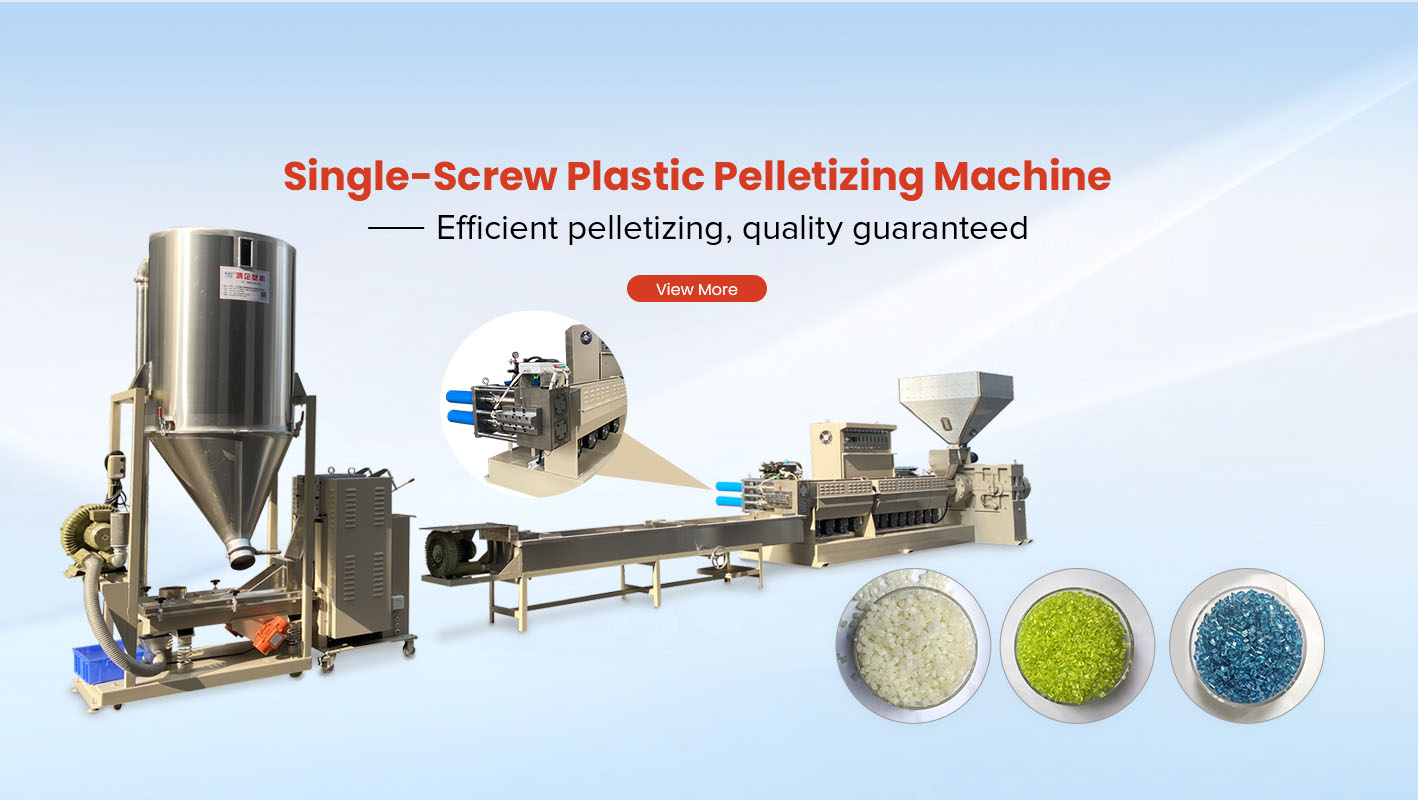
Plastic processing machines can be grouped by what they do to the material: prepare it, melt and shape it, form finished products, recycle waste, or support the main production process. Extruders, injection molding machines, blow molding machines, thermoforming equipment, pelletizers, mixers, conveyors, and granulators all belong to the broader plastic machinery industry.
Machines That Prepare Raw Material
Plastic production begins with material preparation. Resin, recycled flakes, additives, pigments, and fillers must be delivered in a stable condition.
Mixers distribute colors and additives through the material before extrusion. Vertical mixers suit many general blending tasks, while horizontal mixers may provide another mixing pattern for specific formulations or batch sizes.
Screw conveyors transfer material between machines and reduce repeated manual handling. Dewatering equipment removes surface moisture from washed plastic. De-coating machines may help separate coatings from selected plastic waste before recycling.
These machines do not create the final product, but they influence the stability of every process that follows.
Extrusion Machines
A plastic extruder continuously pushes heated and plasticized material through a die. The die determines the initial shape of the output.
Extrusion is used for:
Single-screw extruders are common for stable thermoplastic processing. Twin-screw extruders are often selected for stronger mixing, additive distribution, and compounding.
In a pelletizing line, the extruder produces strands or another melt form that will be cooled and cut into granules.
Injection Molding Machines
Injection molding machines melt plastic and inject it into a closed mold under pressure. After cooling, the mold opens and ejects the finished component.
This method is used for caps, housings, containers, automotive parts, electrical components, and many other products with repeatable three-dimensional shapes.
Unlike continuous extrusion, injection molding operates in cycles. Mold cost and clamping force are major considerations, especially for large or complicated parts.
Blow Molding Equipment
Blow molding forms hollow products by expanding softened plastic against the inside of a mold. It is widely used for bottles, containers, drums, and selected automotive components.
Different blow molding processes are available according to the material, product volume, neck design, and production requirement.
Material consistency is important because uneven melt or contamination can create thin areas, surface defects, or leakage in the finished container.
Thermoforming Machines
Thermoforming heats a plastic sheet and shapes it over or into a mold. Vacuum, pressure, or mechanical assistance may be used.
Packaging trays, disposable containers, appliance liners, and display products are common applications. The sheet thickness, heating uniformity, forming depth, and trimming process all affect product quality.
Plastic Recycling and Pelletizing Machines
Recycling lines prepare waste plastic and convert it into material that can be processed again. Depending on the waste stream, the system may include shredding, washing, dewatering, drying, mixing, extrusion, filtration, cooling, cutting, and screening.
A Strand Pelletizer cuts cooled plastic strands into reusable pellets. A vibrating screen can separate fines and oversized particles after cutting.
Engineering plastics such as PC, PMMA, PA, ABS/PC, PET, and PBT may require stricter temperature and residence-time control than general-purpose PP or PE.
How to Select Machinery for a Factory
The correct machine depends on the starting material and desired output. Buyers should define:
Polymer type
Raw-material form
Moisture and contamination
Required finished product
Hourly output
Quality tolerance
Available electricity and water
Factory space
Operator experience
Future expansion plan
Purchasing each machine separately without checking line compatibility can create problems at transfer points. Capacity should be balanced from preparation through final collection.
Our Role in Plastic Machinery Supply
As an OEM ODM plastic machinery manufacturer, we design and produce single-screw pelletizing extruders, twin-screw pelletizing machines, Auxiliary Equipment, and Spare Parts.
Our product range supports recycling, compounding, PC and PMMA processing, LED light-diffusion materials, building panels, and other plastic applications. CNC machining centers help maintain component accuracy and manufacturing efficiency.
Customization can include screw and barrel configuration, output level, temperature zones, motor and inverter selection, line layout, auxiliary equipment, control requirements, and electrical standards. The process should be based on actual material rather than copying a standard machine list.
One Industry, Many Machine Functions
Plastic machinery covers every stage from raw-material preparation to finished-product forming and recycling. Understanding these categories helps buyers identify which equipment belongs in one complete process.
A recycling factory may not need an injection molding machine, while a molding plant may still need mixers, conveyors, dryers, and granulation equipment for its internal waste.
Plan a Customized Plastic Processing Line
Send us your raw material, finished-product goal, process flow, output requirement, and plant conditions. We can identify the necessary machinery and prepare an OEM or ODM line proposal.