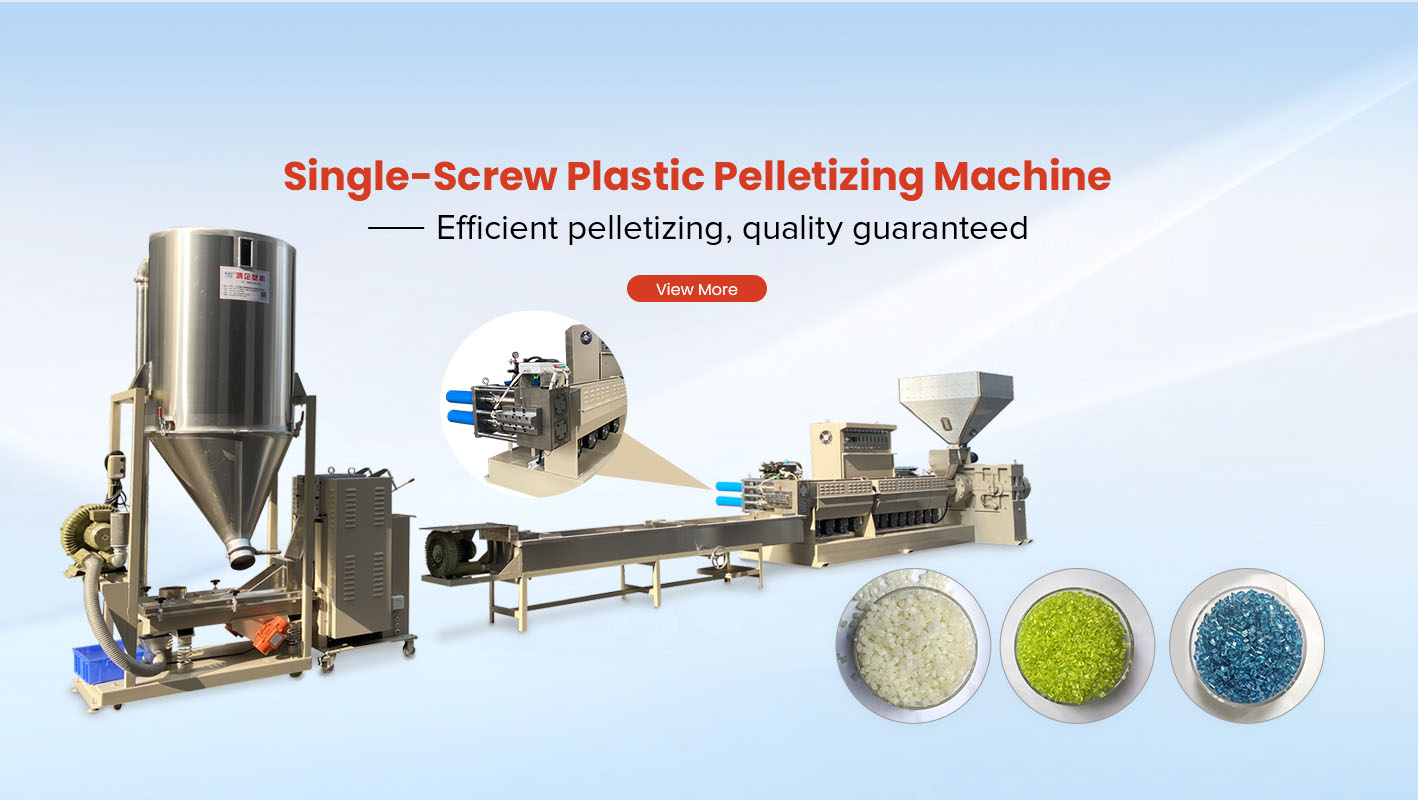
The main types of plastic pelletizers are Strand Pelletizers, water-ring or die-face pelletizers, underwater pelletizers and air-cooled hot-cut systems. The correct choice depends on melt behavior, output, pellet shape, moisture tolerance and cleaning requirements. An OEM/ODM manufacturer of plastic pelletizer machines should evaluate these conditions before choosing the cutter and cooling method.
One Cutting Method Does Not Suit Every Polymer
Pelletizing begins after the extruder has produced a stable, filtered melt. What changes between systems is where the polymer is cut and how the pellets are cooled.
| Pelletizer Type | Where Cutting Happens | Cooling Method | Common Reason for Selection |
|---|
| Strand Pelletizer | After strands leave the cooling section | Water bath or controlled cooling | Straightforward operation and visible strand quality |
| Water-ring pelletizer | At the die face | Circulating water ring | Compact continuous production |
| Underwater pelletizer | At the die face inside a water chamber | Immediate water cooling | High output and rounded pellets |
| Air-cooled hot-cut pelletizer | At or near the hot die | Air conveying and cooling | Materials or processes where water is undesirable |
Strand pelletizing is easy to understand and inspect. The extruder pushes multiple strands through the die, the strands cool, and rotating knives cut them into short cylinders.
Operators can see strand stability before cutting, which helps during setup. Color or material changes can also be relatively manageable.
Problems arise when strands break repeatedly, stick together or reach the cutter at an inconsistent temperature. Die flow, water temperature, pull speed and blade condition all affect the result.
Our website lists strand pelletizers and other auxiliary equipment that can be combined with single-screw or twin-screw extrusion systems.
Water-Ring and Die-Face Pelletizers
A die-face cutter slices the polymer as it leaves the die. Water carries the hot pellets away and begins cooling them.
This arrangement reduces the need to guide long strands manually. It is often considered for continuous production where a compact layout is important. However, die condition, cutter contact and water circulation must remain stable.
Material behavior matters. A polymer that smears, agglomerates or behaves poorly at the die face may need a different pelletizing arrangement.
Underwater Pelletizers
An underwater pelletizer cuts the molten polymer inside a water-filled chamber. Rapid cooling helps form compact, comparatively rounded pellets.
Such systems are widely associated with high-throughput compounding and polymer production. They involve more supporting equipment and process control than a basic strand line. Water circulation, filtration, pellet drying and die-plate temperature all become part of operation.
The larger investment is most reasonable when output and pellet consistency justify the additional system complexity.
Air-Cooled Hot Cutting
Air-cooled systems cut hot material and carry the pellets away without placing them in a cooling bath. This can be useful where contact with water is undesirable.
Cooling efficiency and the tendency of pellets to stick together require attention. The system must remove heat quickly enough before storage or screening.
Match the Pelletizer to the Extruder
The cutter should not be selected independently. Extruder output, number of die holes, melt strength and expected pellet dimensions determine the required cutting capacity.
An OEM/ODM manufacturer of plastic pelletizer machines will normally request:
polymer and additive formulation;
melt temperature;
expected hourly output;
preferred pellet size and shape;
available floor space;
acceptable pellet moisture;
cleaning and color-change frequency.
Our factory manufactures plastic pelletizing machinery and supporting equipment, with CNC machining centers used to support component accuracy. We can configure single-screw, twin-screw or two-stage systems according to the application rather than forcing one cutter type into every project.
Select the Right Pelletizer for Your Material
Provide a material sample or technical data sheet together with target capacity and pellet requirements. We can compare the practical cutting options and prepare a line proposal. To discuss your application with our OEM/ODM manufacturer of plastic pelletizer machines, click here to request technical pricing.