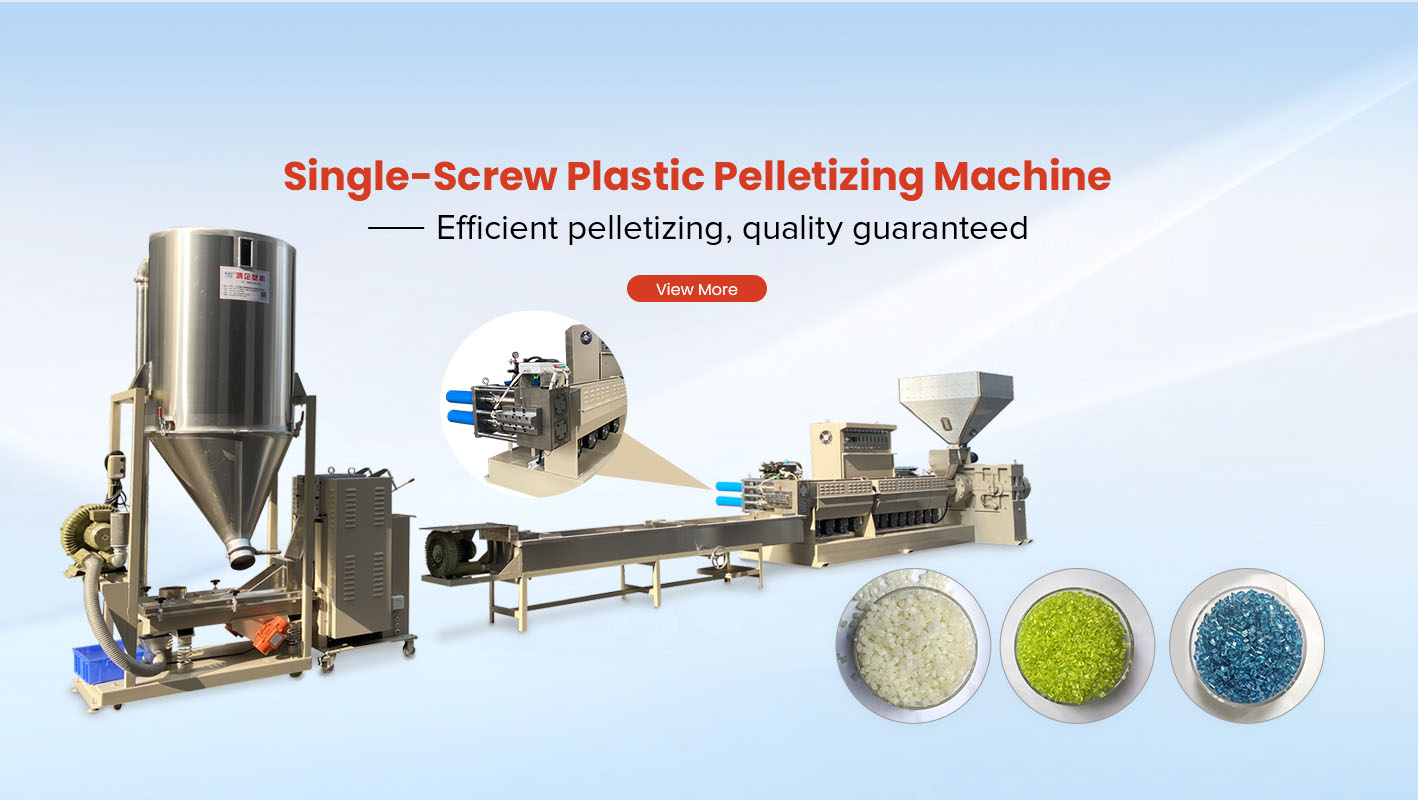
Single-screw and twin-screw pelletizers serve different plastic-processing needs. A single-screw pelletizer is often effective for stable extrusion, routine recycling, and relatively consistent thermoplastic feedstock. A twin-screw pelletizer provides stronger mixing, more flexible formulation control, and better dispersion for many compounding and modification applications.
The right choice depends on what happens inside the barrel. Buyers should assess material condition, additive loading, mixing difficulty, degassing demand, output target, and finished-pellet specifications before comparing equipment prices.
The Main Mechanical Difference
A single-screw extruder uses one rotating screw inside the barrel to convey, compress, melt, and pressurize the polymer. Its relatively straightforward structure can make operation, cleaning, and maintenance easier in suitable applications.
A twin-screw extruder uses two interacting screws. Depending on the design, Screw Elements can be arranged to create different conveying, kneading, mixing, venting, and pressure-building zones. This gives the processor greater control over complex formulations.
Neither design is inherently superior. Each becomes more effective when matched to the correct process.
When a Single-Screw Pelletizer Makes Sense
A single-screw plastic pelletizing extrusion machine can be a practical choice when:
The raw material is reasonably consistent
Intensive additive dispersion is not required
The primary objective is melting and re-pelletizing
Operation and maintenance simplicity are priorities
The processor handles common thermoplastics
The production recipe changes infrequently
Single-screw equipment is used with materials such as PP, PE, ABS, PS, PC, pmma, and other thermoplastics when the machine configuration suits the specific feedstock.
Actual performance still depends on screw design, length-to-diameter ratio, feeding behavior, motor torque, heating and cooling control, filtration, and cutting method.
When a Twin-Screw Pelletizer Is Better
A twin-screw plastic pelletizing extrusion machine is frequently selected for:
The modular nature of many twin-screw systems allows the process section to be arranged for feeding, melting, kneading, venting, and pressure development. Side feeding may also be considered for fillers or additives that should enter after the polymer has begun melting.
Stronger mixing is useful only when it is controlled. Excessive shear or residence time can damage a heat-sensitive polymer, shorten reinforcement fibers, or alter color.
A Practical Comparison
| Selection factor | Single-screw pelletizer | Twin-screw pelletizer |
|---|
| Main strength | Stable conveying and extrusion | Mixing and formulation flexibility |
| Typical use | Recycling and re-pelletizing | Compounding and modification |
| Material recipe | Relatively consistent | Multi-component or demanding |
| Process adjustment | More straightforward | More configuration possibilities |
| Operator requirement | Usually simpler | Requires greater process knowledge |
| Maintenance scope | Fewer process elements | More screw elements and complexity |
| Initial investment | Often lower for comparable basic duty | Often higher due to advanced construction |
| Best decision basis | Feed stability and extrusion demand | Dispersion, mixing, and devolatilization demand |
This comparison is directional. Final selection should be based on representative material, test objectives, and the complete line configuration.
Do Not Choose by Output Alone
A high nameplate capacity does not guarantee saleable pellets. Throughput can change with:
Bulk density
Material moisture
Filler percentage
Melt viscosity
Contamination
Filter condition
Die resistance
Cooling capacity
Pellet dimensions
Buyers should define acceptable output together with pellet uniformity, color, dispersion, moisture, fines, and production stability.
Our Engineering Approach
We manufacture both single-screw and twin-screw pelletizing equipment, allowing the recommendation to begin with the process rather than a single machine category. Our experience covers recycling, modification, and granulation of commercial plastics, engineering plastics, high-performance materials, and special polymer applications.
As an industrial plastic pelletizing equipment supplier, our team reviews samples or material data before recommending screw structure, motor power, temperature zones, vacuum configuration, filtration, strand cooling, cutting, screening, and Auxiliary Equipment. Output options vary by model and material, so each capacity target must be technically evaluated.
Our factory also uses CNC machining centers to support equipment precision. Quality checks cover raw materials, work in progress, assembly, and finished-machine operation, while after-sales support includes installation guidance, operator training, technical assistance, and Spare Parts.
Final Selection Rule
Choose a single-screw pelletizer for stable, comparatively straightforward extrusion and recycling work. Choose a twin-screw pelletizer when the process requires intensive mixing, controlled dispersion, multi-component feeding, or greater formulation flexibility.
The most reliable answer comes from matching the machine to the polymer and desired pellet—not from assuming that two screws must always outperform one.