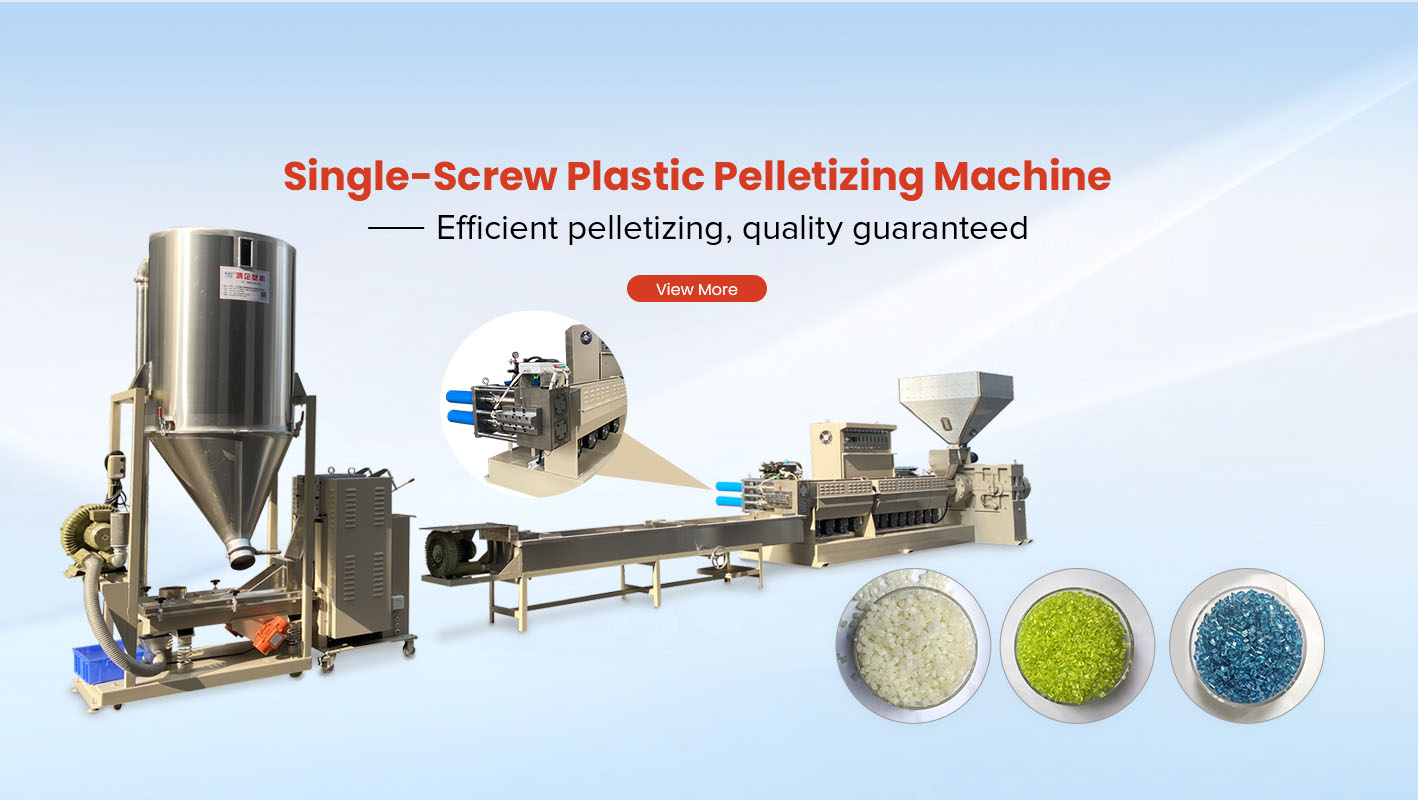
A plastic pelletizing machine is an industrial system that converts thermoplastic raw material or prepared plastic waste into consistently sized pellets for reuse in extrusion, injection molding, compounding, and other manufacturing processes. A complete plastic pelletizing line normally includes feeding, conveying, melting, mixing, filtration, extrusion, cooling, cutting, screening, and collection stages.
Pelletizing does more than reduce the size of plastic. The process creates a controlled, flowable feedstock that is easier to package, transport, meter, blend, and process than irregular flakes or agglomerated waste.
What Materials Can Be Pelletized?
The correct plastic recycling pelletizing machine depends on the polymer, contamination level, moisture, bulk density, thermal stability, additives, and required output. Common materials include:
These materials cannot all use one universal processing recipe. PET and PA, for example, may require careful drying, while transparent PC or PMMA demands stricter contamination and temperature control when clarity and color are important.
PVC requires a machine configuration and process window suited to its heat sensitivity. Buyers should always provide representative material information before equipment selection.
1. Material Preparation
Post-industrial scrap, washed flakes, regrind, or virgin resin is sorted and prepared. Metal, dust, labels, coatings, excessive moisture, and incompatible polymers should be removed as far as practical.
A mixer may be used to distribute colorants, fillers, modifiers, or other additives before extrusion. Low-bulk-density material may require a specialized feeding solution to maintain stable throughput.
2. Feeding and Conveying
Prepared material enters the extruder through a hopper or controlled feeder. Consistent feeding is important because fluctuating input can change barrel pressure, residence time, melting behavior, and output.
3. Melting and Plasticizing
The rotating screw conveys the material along a heated barrel. Heat from the barrel and mechanical shear gradually soften, compress, melt, and homogenize the polymer.
The objective is not simply to use the highest temperature. Excessive heat can cause degradation or discoloration, while insufficient heat may leave unmelted particles and produce unstable strands.
4. Degassing and Filtration
Moisture, air, and volatile compounds may be removed through venting or a vacuum system. Melt filtration then captures contaminants that should not enter the finished pellets.
Filter selection must balance cleanliness with pressure stability. A screen that becomes blocked too quickly can interrupt production, but filtration that is too coarse may allow defects to remain.
5. Extrusion and Cutting
The filtered melt exits through a die. In a strand pelletizing process, continuous strands are cooled and fed into a strand pelletizer, where rotating blades cut them into cylindrical pellets.
Other cutting arrangements may be selected according to material behavior and production requirements.
6. Screening and Collection
Finished pellets can pass through a vibrating screen to separate oversized particles, fines, and acceptable product. They are then conveyed, cooled if necessary, and collected for inspection or packaging.
Which Parameters Control Pellet Quality?
Operators commonly monitor:
Feed consistency
Material moisture
Barrel-zone temperatures
Screw speed
Motor load
Melt pressure
Vacuum performance
Cooling conditions
Haul-off stability
Cutter speed
Blade condition
Stable pellets result from balanced operation across the entire line. Adjusting only the cutter cannot correct material surging or unstable extrusion upstream.
Our Manufacturing Support
Our factory has more than 20 years of experience in designing, producing, selling, and supporting plastic pelletizing machinery. We manufacture single-screw, twin-screw, and two-stage pelletizing equipment together with mixers, dewatering machines, de-coating equipment, conveyors, screens, and Spare Parts.
As a plastic pelletizing machine OEM/ODM manufacturer, we can configure screw geometry, motor power, temperature control, feeding, degassing, filtration, cooling, cutting, and downstream equipment around the buyer’s actual material and capacity target. CNC machining capabilities support dimensional accuracy in critical equipment components.
Before preparing a solution, our team reviews the polymer type, input form, contamination, moisture, formulation, expected output, pellet standard, available power supply, and factory layout. Installation guidance, training, technical support, and spare-parts service are also available after delivery.
A Pelletizing Line Is a Connected Process
A plastic pelletizing machine works by turning prepared plastic into a controlled melt, removing unwanted material, forming the melt through a die, and cutting it into reusable pellets. Reliable production depends on every stage working together.
Representative material trials and clearly defined pellet requirements provide a stronger basis for machine selection than capacity figures alone.