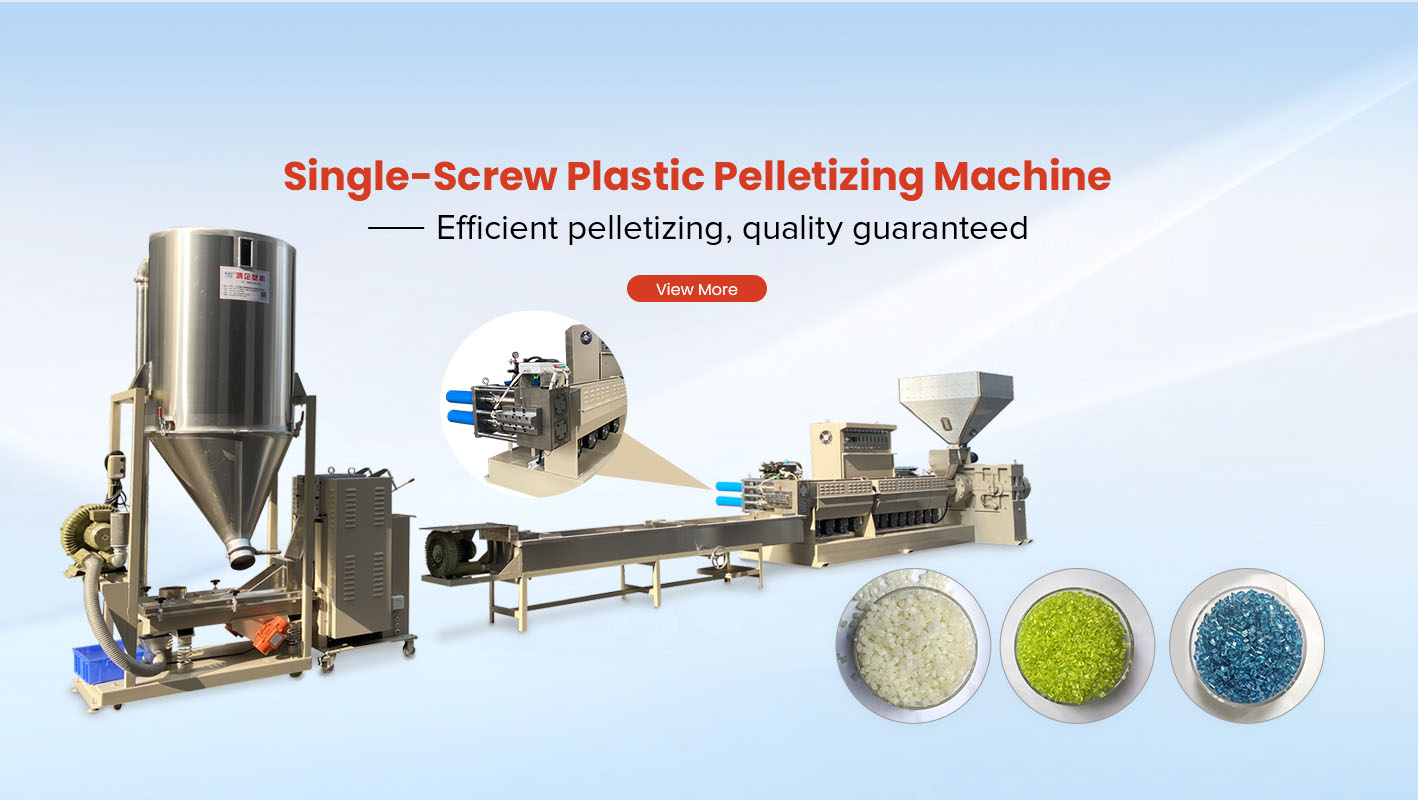
A plastic granulator and a pelletizing extruder both prepare plastic for reuse, but they perform fundamentally different operations. A plastic granulator mechanically cuts solid scrap into flakes or regrind without melting it. A pelletizing extruder heats, melts, homogenizes, filters, and forms plastic into more consistent pellets.
Confusion occurs because “granulator,” “pelletizer,” and “plastic granulation machine” are sometimes used differently across markets. Buyers should describe the required process rather than relying on a machine name alone.
What Does a Plastic Granulator Do?
A conventional size-reduction granulator receives runners, rejected molded parts, sheets, bottles, profiles, or other solid plastic waste. Rotating knives cut the material against stationary knives until pieces are small enough to pass through a screen.
The output is usually irregular regrind. Its particle shape and size depend on:
Rotor and knife design
Screen-hole dimensions
Feed shape
Cutting clearance
Knife sharpness
Material toughness
Machine speed
Granulation does not melt the polymer or remove incompatible plastic. It also does not automatically clean dirt, labels, metal, or oil from the waste.
What Does a Pelletizing Extruder Do?
A pelletizing extruder receives prepared flakes, regrind, agglomerate, powder, or resin. A rotating screw conveys and melts the material inside a temperature-controlled barrel.
The melt may be mixed, degassed, and filtered before it passes through a die. It is then cooled and cut into pellets.
A complete plastic pelletizing extrusion machine therefore changes both the physical form and thermal history of the material. Its output is generally easier to meter consistently into downstream processing equipment than irregular regrind.
The strand pelletizer is the cutting unit downstream of the extruder. It does not normally replace the extruder.
Molten polymer exits the die as continuous strands. After controlled cooling and water removal, the strands enter the cutter. Feed rollers guide them toward rotating blades, which produce cylindrical pellets.
This distinction matters when requesting a quotation. A buyer asking only for a “pelletizer” may receive information about the cutter rather than the complete extrusion line.
When Is Granulation Alone Enough?
Mechanical granulation can be sufficient when clean production scrap will be blended directly back into a compatible manufacturing process. Examples include runners or edge trim from a controlled single-material production environment.
Direct reuse depends on the process, material history, regrind percentage, contamination control, and product-quality requirements. Some operations can accept regrind, while others require consistent pellets or tighter filtration.
When Is Extrusion Pelletizing Necessary?
Pelletizing extrusion becomes more relevant when the processor needs to:
Homogenize irregular feedstock
Mix additives or color
Remove moisture or volatiles
Filter solid contamination
Improve feeding consistency
Produce a standardized pellet form
Prepare recycled material for sale or transport
Control a compounding formulation
The additional thermal cycle must be managed carefully. Excess temperature or residence time can degrade the polymer instead of improving it.
Why Many Recycling Plants Need Both
A complete recycling process may use a crusher or granulator before extrusion:
Scrap is sorted.
Oversized material is reduced in size.
Dirt and foreign matter are removed.
Wet material is dried.
Regrind is fed into the extruder.
The melt is vented and filtered.
Strands are cooled and cut.
Pellets are screened and collected.
Each stage protects the next. Proper size reduction supports stable feeding, while effective cleaning reduces filter loading and final-pellet defects.
Our Complete-Line Perspective
Our factory supplies extrusion pelletizing machinery and associated equipment for plastic recycling and modification. Available solutions include single-screw, twin-screw, and two-stage pelletizing lines, along with mixers, de-coating equipment, dewatering machines, Screw Conveyors, vibrating screens, strand cutters, and Spare Parts.
As a commercial-grade plastic recycling equipment supplier, we do not select equipment from the product name alone. Our engineers review the incoming scrap, preparation method, polymer, contamination, moisture, capacity, filtration requirement, pellet dimensions, and intended end use.
More than 20 years of design and production experience helps us connect upstream preparation with stable extrusion and downstream pellet handling. CNC machining, production inspection, final testing, installation guidance, training, and technical support contribute to the complete equipment program.
The Difference in One Sentence
A plastic granulator cuts solid waste into smaller pieces; a pelletizing extruder melts and reforms prepared plastic into pellets.
Buyers who provide material samples, photos, production data, and final quality expectations will receive a far more accurate solution than those who request a “plastic granulator” without defining the required process.