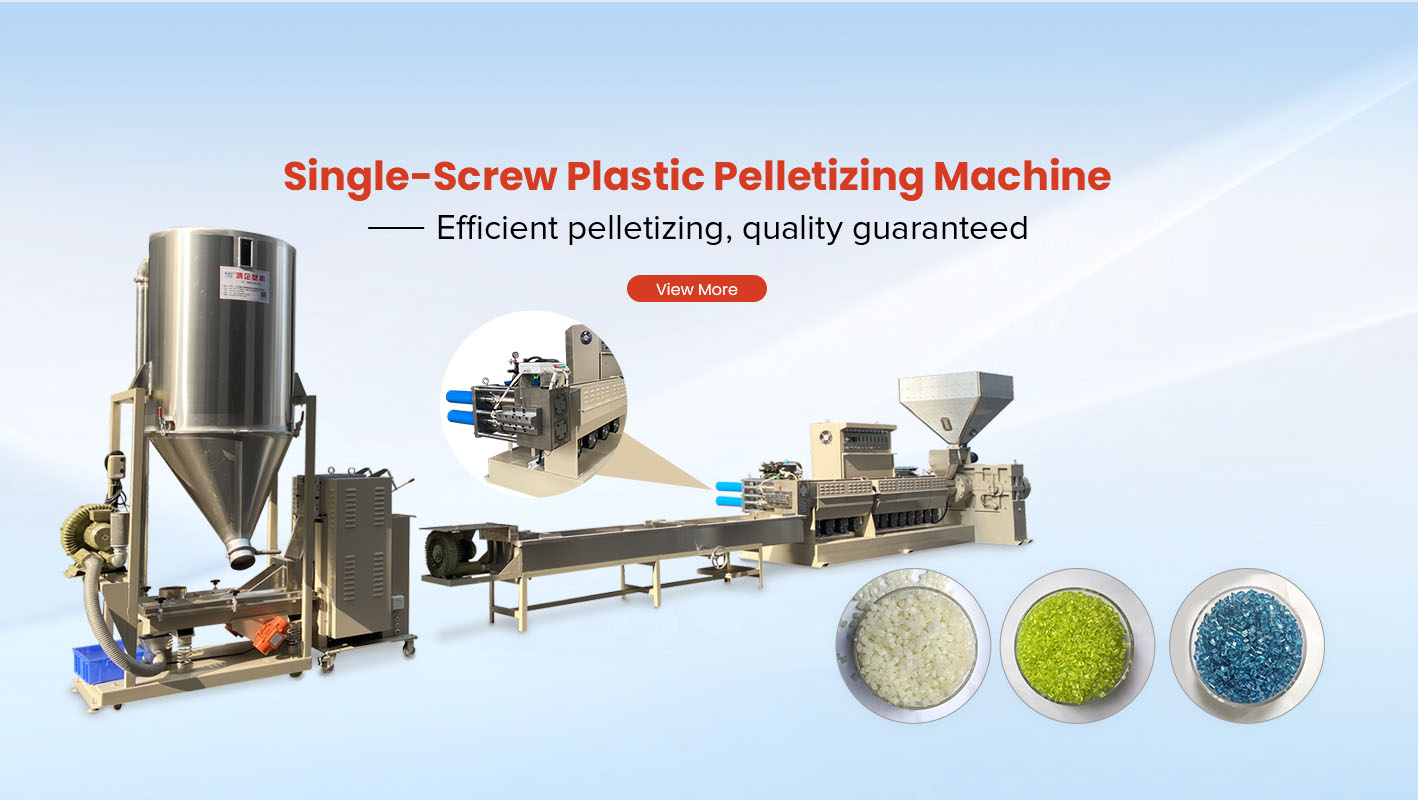
Recycled plastic pellets vary in size and color because their final appearance is affected by feedstock consistency, polymer degradation, contamination, melt stability, cooling, strand movement, cutter condition, and screening efficiency. Small visual differences may be acceptable for some applications, but wide variation can signal unstable production or inadequate material preparation.
Consistent recycled plastic pellet size and color begin before extrusion. Pelletizing equipment can stabilize a suitable process, but it cannot fully compensate for badly mixed, contaminated, or incorrectly identified waste.
Why Pellet Size Changes
Unstable Extrusion Output
Fluctuating feeding causes changes in melt pressure and strand diameter. Low-bulk-density flakes or film can bridge inside the hopper, producing alternating periods of low and high output.
Variable moisture can worsen the problem by generating bubbles or inconsistent strands.
Uneven Cooling
Strands that are too warm can flatten, stretch, or stick during cutting. Strands that become too cold or brittle may break before reaching the pelletizer.
Water temperature, cooling-path length, strand spacing, and haul-off speed should be balanced with production output.
Cutter-Speed Mismatch
Pellet length is affected by strand speed and cutter speed. When extrusion output rises but the cutter does not compensate, pellet length can change.
Worn blades, incorrect blade clearance, damaged feed rollers, or material accumulated near the cutting chamber may also create tails, fines, chips, and irregular cuts.
Strand-Diameter Variation
Blocked die holes, uneven temperature across the die, or poor melt distribution can make some strands thicker than others. Even perfect cutting intervals will then produce pellets with different mass.
Inadequate Screening
A vibrating screen separates acceptable pellets from fines and oversized pieces. Incorrect screen selection or poor material flow can allow out-of-spec particles to remain in the finished batch.
Why Recycled Pellets Change Color
Color variation commonly originates in the feedstock. Mixed shades, printed film, labels, coatings, fillers, pigments, and different recycled-plastic grades can produce an inconsistent melt color.
Other causes include:
Excessive barrel temperature
Long material residence time
Polymer oxidation
Contamination from a previous production run
Burnt material in dead zones
Inadequate mixing
Uneven masterbatch dosing
Degraded material returning to the process
Metal or carbonized particles passing through filtration
Transparent or light-colored pellets make small contaminants and heat damage particularly visible. Applications using PC or pmma therefore demand disciplined sorting, cleaning, equipment purging, and temperature control.
Does Darker Color Always Mean Poor Quality?
Not necessarily. Recycled pellets can be intentionally produced in dark colors to accommodate mixed feedstock or specific product requirements. Visual appearance alone does not establish mechanical performance.
Quality should be assessed against the intended application through relevant measurements such as:
Melt-flow behavior
Moisture
Contamination level
Pellet-size distribution
Bulk density
Color difference
Mechanical properties
Filler or ash content
The necessary tests depend on the polymer and the customer’s downstream process. A uniform-looking pellet can still contain degraded or incompatible material.
How to Improve Pellet Uniformity
Begin by separating polymers and colors at the source. Wash and dry the material consistently, control regrind size, and remove metal and nonplastic contamination.
During extrusion, stabilize:
Feeding rate
Barrel temperatures
Screw speed
Melt pressure
Vacuum level
Screen condition
Cooling temperature
Strand speed
Cutter speed
Blade clearance
Operators should record these variables with batch information. Traceable process records make it easier to connect a pellet defect to material changes, filter replacement, temperature drift, or cutting conditions.
Equipment Configuration for Stable Recycled Pellets
A suitable screw design helps create stable melting and conveying. Venting removes moisture and volatile compounds, while filtration captures solid contamination. The die should distribute the melt evenly, and the cutter must match strand output.
Our factory produces complete pelletizing solutions for materials including PP, PE, ABS, PS, PC, PMMA, PA, PET, PBT, and polymer blends. The final configuration depends on the specific resin, recycling history, additive system, contamination, and required pellet standard.
As a reliable export supplier of recycled plastic pelletizing machines, we can tailor feeding, screw configuration, temperature control, degassing, filtration, cooling, cutting, screening, and conveying around the buyer’s actual production conditions. Our equipment range also includes mixers, de-coating machines, dewatering units, Screw Conveyors, and Spare Parts.
Our production and quality-control process covers component preparation, CNC machining, assembly, inspection, and operational testing. After shipment, we provide installation guidance, training, technical assistance, and replacement-part support to help operators maintain stable performance.
Uniform Pellets Require Uniform Control
Pellet size depends mainly on stable melt output, cooling, cutting, and screening. Pellet color depends largely on material sorting, contamination, formulation, residence time, and temperature history.
Consistent recycled pellets are not created by one machine adjustment. They result from disciplined feedstock management and coordinated control of the entire plastic pelletizing line.