There is no single standard volume for every plastic water bottle.
A small bottle may hold 250 or 330 milliliters, while common retail bottles may contain 500, 600, 750, 1,000, or 1,500 milliliters. The correct amount is printed on the label.
In the United States, beverage volume is commonly shown in fluid ounces. A fluid ounce measures volume, not the weight of the bottle or water.
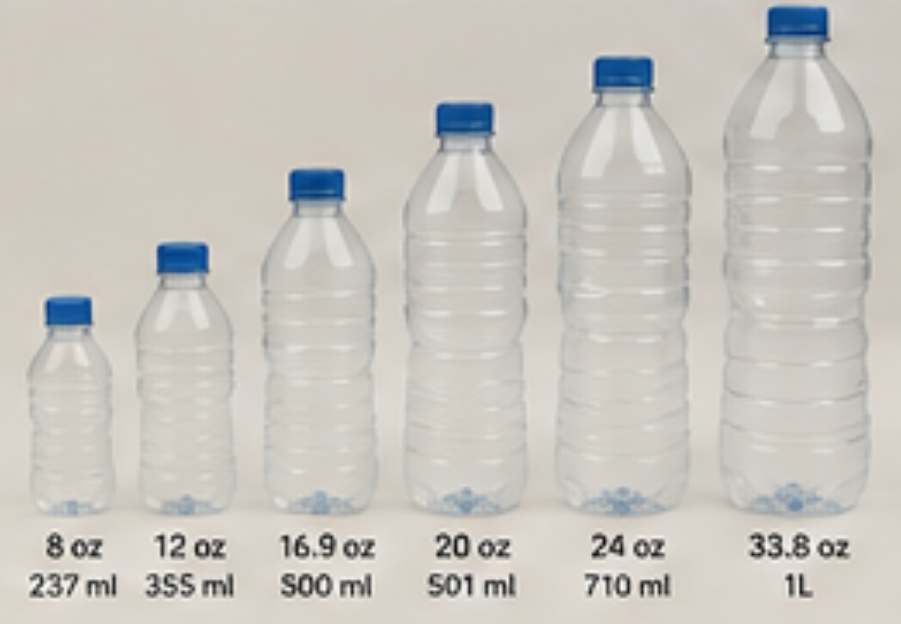
Common Bottle Volume Conversions
| Metric Volume | Approximate US Fluid Ounces |
|---|
| 250 mL | 8.5 fl oz |
| 330 mL | 11.2 fl oz |
| 500 mL | 16.9 fl oz |
| 600 mL | 20.3 fl oz |
| 750 mL | 25.4 fl oz |
| 1 liter | 33.8 fl oz |
| 1.5 liters | 50.7 fl oz |
The printed label should be used instead of estimating volume from the bottle’s external size.
Why 500 mL Is Often Called 16.9 Ounces
One US fluid ounce is approximately 29.57 milliliters.
Dividing 500 milliliters by that value gives approximately 16.9 US fluid ounces.
In countries using imperial fluid ounces, the number will be slightly different because the imperial and US units are not identical.
Does Bottle Shape Affect Capacity?
Yes. Two bottles can look similar but hold different amounts.
Capacity is affected by:
Manufacturers design bottles around filling equipment, transportation, shelf presentation, material use, and consumer handling.
Why Bottle Size Matters in Packaging
A larger bottle does not simply use the same design enlarged.
The bottle may require a different preform, wall distribution, base structure, cap, label size, carton arrangement, and pallet pattern.
The filling line must also be adjusted for the target volume.
Bottle Size and Recycling Logistics
Bottle size influences how waste is collected and transported.
Large empty bottles occupy more space, but compacting or crushing can reduce transportation volume. After sorting, the bottles may be crushed into flakes for washing.
Why Moisture Must Be Controlled
Washed plastic flakes can retain water on the surface and between irregular pieces.
Excess moisture may affect drying, feeding, extrusion stability, energy consumption, and pellet appearance.
A Vertical Plastic Dewatering Machine removes part of this moisture before the flakes enter additional drying or pelletizing stages.
How a Plastic Dewatering Machine Works
A vertical dewatering system uses high-speed mechanical movement to separate water from washed plastic.
The wet material enters the machine, moves through the internal rotor and screen structure, and exits with lower surface moisture.
The exact result depends on:
Plastic type
Flake size
Initial moisture
Screen condition
Rotor speed
Feeding stability
Machine capacity
Downstream requirements
Dewatering is not always the final drying step. Some materials still need hot-air or other controlled drying before extrusion.
Materials Our Dewatering Equipment Can Process
Our vertical dewatering equipment is intended for prepared plastic materials such as PET, PP, PE, ABS, and PS flakes or regrind.
The machine can be integrated with washing, conveying, drying, extrusion, and pelletizing equipment according to the complete process.
Plan a Bottle-Flake Drying Line
Preparing to recycle bottles, rigid packaging, containers, or mixed washed plastic?
Provide the resin type, flake size, initial moisture, target moisture, hourly output, water-treatment arrangement, workshop layout, and downstream equipment. We will recommend a Vertical Plastic Dewatering Machine and matching line configuration.