A pmma diffuser usually prioritizes high light transmission, weather resistance, and long-term optical appearance. A PC diffuser prioritizes impact strength, thermal performance, and resistance to breakage. Both can produce uniform lighting, but the correct choice depends on the fixture, installation environment, LED temperature, safety requirements, and expected service conditions.
The word “diffuser” describes the lighting function, not one specific plastic. Diffusion performance comes from the interaction between the base resin, optical additives, sheet structure, and extrusion process.
How a Plastic Diffuser Controls Light
A transparent sheet allows most light to pass directly through it. A diffuser changes the direction of the light so individual LED points become less visible.
This effect can be produced through:
Light-diffusing particles in the resin
White or translucent masterbatch
Embossed surface patterns
Matte textures
Multilayer sheet structures
Controlled sheet thickness
Internal optical structures
A diffuser with very high haze may hide LED hotspots effectively but reduce total light output. A sheet with high transmission may provide better efficiency but reveal individual LEDs when the spacing is too wide.
Lighting manufacturers therefore need to balance transmission, haze, color consistency, impact strength, and cost.
Pmma Diffuser Characteristics
PMMA is widely used for LED panels, advertising light boxes, decorative fixtures, light guides, and architectural lighting.
Its main advantages include:
High visible-light transmission
Strong surface gloss
Good natural weather resistance
Stable outdoor appearance
Good surface hardness
Efficient light guidance
PMMA is often preferred for indoor decorative lighting and outdoor applications where long-term clarity and resistance to yellowing are important.
Its limitation is lower impact resistance. Thin covers, large panels, or products exposed to transportation damage may require thicker sections, impact-modified grades, or additional structural support.
PC Diffuser Characteristics
PC is commonly used in tube lights, industrial lighting, transport lighting, protective covers, and fixtures exposed to heat or mechanical impact.
Its advantages include:
High impact resistance
Better resistance to cracking
Good dimensional stability
Higher heat capability
Availability of flame-retardant grades
Suitability for demanding housings and covers
PC can be a better choice for factories, warehouses, public areas, transport equipment, or fixtures where accidental impact is possible.
However, the grade should be selected carefully for UV exposure, scratch resistance, flame performance, and optical requirements.
Why Granule Quality Affects the Final Diffuser
Even a well-designed diffuser formula can fail when the granules are poorly compounded.
Common granule defects include:
Uneven additive dispersion
Moisture bubbles
Yellowing from excessive heat
Black spots from degraded residue
Inconsistent pellet size
Contamination from another resin
Unstable melt flow
Excessive fines after cutting
These problems can create light spots, streaks, variable haze, unstable sheet thickness, or color differences between production batches.
The pelletizing line should provide stable feeding, uniform melting, suitable shear, controlled filtration, and consistent cutting without subjecting transparent resin to unnecessary residence time.
Equipment Support for Diffuser Compound Production
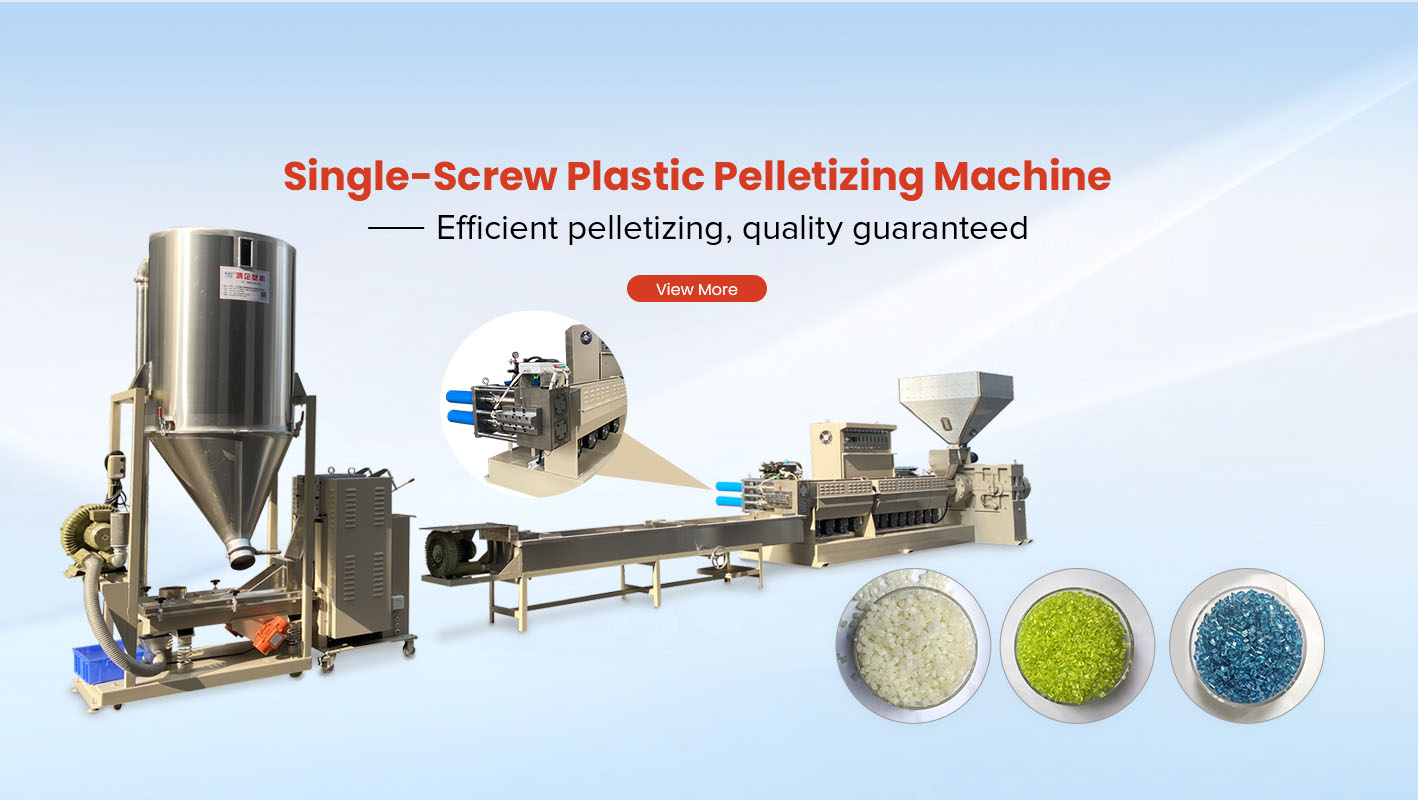
As a plastic diffuser granule machine OEM / ODM Manufacturer, our factory develops pelletizing equipment around the customer’s PC, PMMA, PS, additive, masterbatch, and optical-performance requirements.
Our LED diffuser granule equipment can include precision screw design, multi-zone temperature control, ceramic die heating, continuous filtration, water cooling, strand cutting, and vibrating screening.
One published HQ-65 configuration uses:
A 65 mm single screw
An L/D ratio around 35
Four-section temperature control
Inverter speed regulation
Automatic feeding
Stainless steel cooling tank
Variable-speed pellet cutting
Multilayer vibrating screening
The final line is adjusted according to the formulation, output, additive percentage, pellet quality, and available production space.
Develop a Stable Diffuser Pellet Line
Send us the base material, light-diffusing additive, target transmission and haze, hourly capacity, pellet dimensions, current defect photographs, and downstream sheet-extrusion requirements.
Our technical team can review the material route and prepare an OEM/ODM machine configuration covering mixing, feeding, extrusion, filtration, cooling, pelletizing, screening, installation, training, and spare-parts support.