Industrial plastics are commonly divided into commodity thermoplastics, engineering plastics, high-performance polymers, thermosets, elastomers, and reinforced or compounded materials. These groups describe performance and processing behavior more accurately than simply calling every polymer “plastic.”
The different types of industrial plastics cannot share one universal processing method. A clean PP regrind, moisture-sensitive polycarbonate, glass-fiber-reinforced nylon, and crosslinked thermoset waste present entirely different extrusion and recycling challenges.
Start With Processing Behavior
The most important first division is between thermoplastics and thermosets.
Thermoplastics soften when heated and can usually be reshaped under controlled conditions. This makes mechanical recycling and extrusion pelletizing possible for many grades, although repeated heat exposure can still cause degradation.
Thermosets cure into a permanently crosslinked structure. Once cured, they do not melt and flow like conventional thermoplastics. They may be ground for use as filler in certain applications, chemically processed through specialized methods, or directed to other recovery routes, but they cannot simply be remelted into normal pellets.
Elastomers form a third broad group. Some are crosslinked rubbers that do not remelt, while thermoplastic elastomers can be processed using thermoplastic equipment.
Commodity Thermoplastics
Commodity plastics are produced in large volumes and used across packaging, construction, consumer goods, and general manufacturing.
The main examples include:
Their widespread use does not make processing simple. Post-consumer PE film may be wet and contaminated, PP products may contain mineral filler, and PVC requires careful thermal control. Material condition matters as much as resin name.
Engineering Plastics
Engineering plastics are selected for higher mechanical strength, dimensional stability, heat resistance, impact performance, or electrical properties.
Typical materials include:
ABS
Polycarbonate
Polyamide
Polybutylene terephthalate
Polyoxymethylene
pmma in optical and appearance-focused applications
PC/ABS and other polymer blends
Many engineering plastics need controlled drying and narrower processing windows. Transparent PC or PMMA also demands careful contamination and discoloration control. Reinforced engineering compounds can accelerate screw and barrel wear.
High-Performance Polymers
High-performance plastics are used where conventional engineering materials cannot provide sufficient heat, chemical, flame, or wear resistance. Examples include PEEK, PPS, PEI, fluoropolymers, and high-temperature polyamides.
Their raw-material cost is high, and their processing temperatures or corrosion characteristics may require specialized metallurgy, heating capacity, screw geometry, ventilation, and safety controls. A standard recycling line should not be assumed suitable.
Reinforced, Filled, and Modified Plastics
Many industrial plastics are compounds rather than pure resins. Manufacturers add glass fiber, carbon fiber, calcium carbonate, talc, pigments, flame retardants, impact modifiers, lubricants, and stabilizers to achieve targeted properties.
Compounding requires accurate feeding and effective dispersion. Too little mixing produces poor uniformity, while excessive shear may damage fibers, degrade the polymer, or increase temperature unnecessarily.
This is where a twin-screw plastic pelletizing extrusion machine is often considered. Intermeshing screws can provide controlled conveying, distributive mixing, dispersive mixing, venting, and additive incorporation when configured correctly.
Recycled Industrial Plastics
“Recycled plastic” is not a separate polymer family. It describes material history. Recycled pellets can be made from PP, PE, ABS, PC, PET, and many other thermoplastics.
The production route depends on whether the feedstock is clean factory scrap or mixed post-consumer waste. Factory scrap may need only grinding, controlled feeding, melting, filtration, and pelletizing. Dirty post-consumer material can require sorting, washing, dewatering, drying, densifying, degassing, and finer filtration.
Our Equipment Is Built Around the Material Route
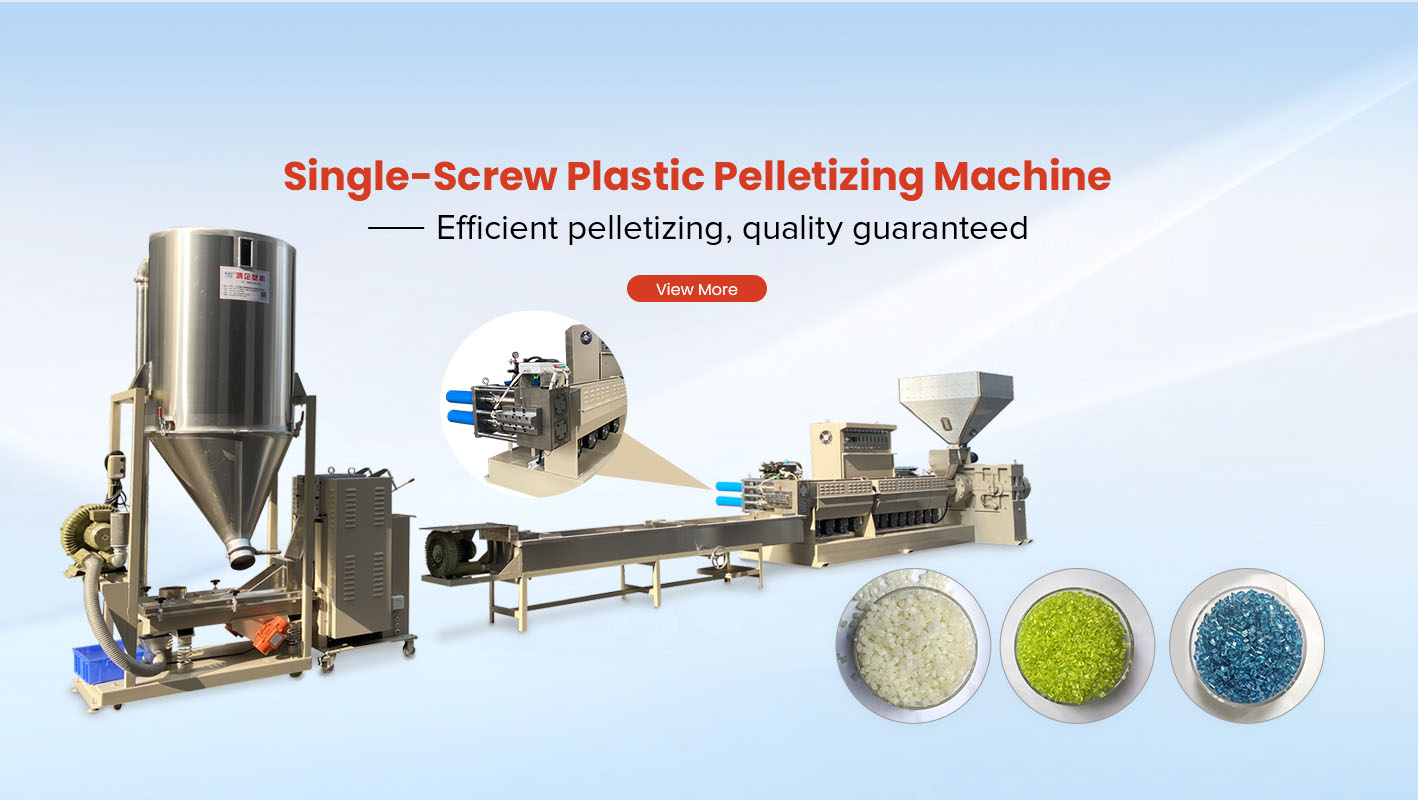
We manufacture complete plastic pelletizing equipment and auxiliary machines for industrial recycling and compounding projects. Our product range includes single-screw and twin-screw extruders, color mixers, horizontal and vertical mixers, Strand Pelletizers, Screw Conveyors, dewatering machines, de-coating equipment, vibrating screens, and replacement components.
As a plastic recycling machinery OEM/ODM manufacturer, we can adjust screw diameter, screw design, motor power, temperature-control layout, feeding arrangement, degassing, filtration, cutting system, and control configuration. We also provide installation guidance, operating training, Spare Parts, and technical support for supplied equipment.
Six Questions to Answer Before Selecting a Machine
What is the exact resin or blend?
Is the feedstock film, flake, powder, fiber, foam, or rigid regrind?
How much moisture and contamination does it contain?
Are fillers, fibers, pigments, or other additives required?
What hourly output and pellet quality are expected?
What will the finished pellets be used to manufacture?
Industrial plastics should be classified by both chemistry and production purpose. Once the material route is clear, the extruder, pretreatment equipment, filtration, degassing, and pelletizing method can be selected on engineering evidence rather than a broad material label.